
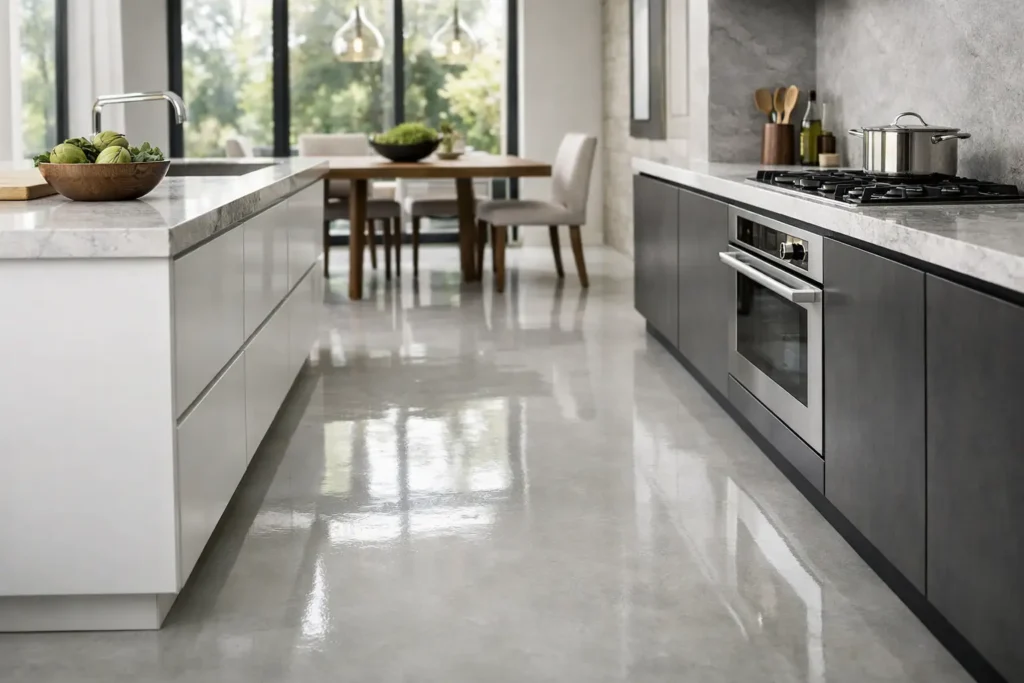
A kitchen floor has a hard job: it carries muddy shoes, chair legs, dropped pans, cooking splashes and the daily rhythm of a busy home. So, is epoxy suitable for kitchens? When it is specified and installed properly, yes. It can create a striking, seamless surface that is practical underfoot and full of design character. The key is choosing resin as a considered architectural finish, rather than treating it as a quick alternative to tiles or vinyl.
For homeowners looking beyond familiar kitchen flooring, epoxy offers something distinctive. It allows the floor to become part of the scheme itself: quiet and concrete-like, soft and terrazzo-inspired, richly metallic, or tailored to a precise colour palette. Yet its visual impact should always be balanced with the practical realities of the room.
Why epoxy works in a kitchen
Epoxy resin is a poured coating system that cures into a continuous, hard-wearing surface. Unlike tiled floors, it has no grout joints to collect crumbs, grease or discolouration. Unlike many plank and sheet finishes, it can run uninterrupted across an open-plan kitchen, dining area and hallway, creating a calmer sense of space.
That seamless quality is more than an aesthetic choice. Kitchens are places where cleaning needs to be straightforward. With no joints to scrub, a properly sealed resin floor can usually be kept looking smart with regular sweeping and a damp mop using a suitable pH-neutral cleaner. Cooking spills, tracked-in dirt and everyday splashes have fewer places to settle.
Epoxy also brings impressive design freedom. A pale terrazzo-style finish can give a compact kitchen more lightness, while a warm stone or concrete effect complements timber cabinetry and brushed metal details. For bolder interiors, decorative chips, layered pigments and subtle movement can make the floor feel genuinely bespoke rather than off-the-shelf.
Is epoxy suitable for kitchens with heavy daily use?
For most residential kitchens, epoxy is more than capable of dealing with normal household traffic. A professionally prepared and coated floor provides a durable surface with good resistance to staining and wear. It is particularly appealing in family homes, pet-friendly spaces and open-plan renovations where the same finish needs to perform across several zones.
However, durability is never simply a product claim. It depends on the condition of the existing subfloor, the resin system selected, the preparation work and the quality of installation. Concrete must be sound, dry enough for the chosen system and correctly prepared to receive the coating. If movement, moisture or cracking in the slab is ignored, no beautiful finish will compensate for that later.
A kitchen also benefits from the right topcoat. The top layer can be selected to provide greater scratch resistance, UV stability where large glazed doors bring in strong daylight, and an appropriate sheen level. Matt and satin finishes are often popular because they feel refined while being more forgiving of fingerprints, dust and the small marks of everyday life than a high-gloss surface.
The practical trade-offs to consider
Epoxy is not a universal answer for every kitchen, and a good decision starts with an honest view of its characteristics. Resin floors are hard underfoot compared with cork, some vinyl products or cushioned flooring. If you spend long periods cooking, a supportive kitchen mat at the sink or hob can make a meaningful difference.
Slipperiness also needs consideration. Any smooth floor can become slippery when wet, especially near sinks, patio doors or utility areas. This does not rule resin out, but it does mean the finish should be specified carefully. A professional can introduce texture or use a lower-sheen, slip-conscious topcoat without compromising the overall design.
Surface scratches are another point of nuance. Epoxy is tough, but it is not indestructible. Dragging heavy appliances, unprotected metal chair legs or grit caught beneath furniture can mark any decorative floor. Felt pads, entrance mats and sensible furniture handling protect the finish and help it mature beautifully. In a busy kitchen, a finish with visual variation, such as terrazzo-inspired flecks or a gentle concrete effect, can disguise minor signs of use more effectively than a perfectly flat block colour.
Heat is often raised as a concern. Normal cooking activity is not a problem for a correctly installed kitchen resin floor, but very hot items should not be placed directly onto it. That is common sense for most surfaces, from timber to laminate. Resin flooring is also distinct from resin worktops: a floor system should be designed for floor traffic, while worktops face a different combination of heat, impact and food-preparation demands.
Designing a resin kitchen floor with intention
The best epoxy kitchens do not look like a warehouse floor brought indoors. They feel connected to the cabinetry, lighting, walls and architecture of the home. That is where bespoke sampling matters.
A soft mineral grey can anchor a contemporary kitchen with oak units. Creamy off-whites and delicate aggregate-style details suit warm, natural schemes. Deeper charcoal shades can make a dramatic statement in a larger room, especially when balanced with lighter joinery and generous daylight. Metallic effects can be compelling in feature spaces, but they require a confident design hand: the finish should enhance the room rather than compete with every other element in it.
Consider how the surface will read throughout the day. Resin has a depth that responds to natural light, pendant lighting and the changing shadows of an open-plan room. A sample viewed only under showroom lighting cannot tell the whole story. Testing colours and sheen levels within the kitchen itself gives a far more reliable sense of the finished atmosphere.
It is also worth deciding where the floor begins and ends. A continuous resin finish through a kitchen and dining space can make a modest footprint feel more expansive. In a period property, it may be used as a crisp contemporary counterpoint to original features. In a new extension, it can bring visual continuity from the kitchen to the garden-facing doors, particularly where thresholds are detailed carefully.
Installation is where performance is made
A seamless floor looks simple once complete. The work beneath it is anything but. Professional installation starts with assessing the substrate and its moisture condition, then repairing cracks or imperfections and mechanically preparing the surface so the resin can bond correctly. Primers, base coats, decorative layers and protective topcoats are built up as a system rather than applied as a single paint-like coating.
Curing time must be planned around the household. Kitchens are high-use rooms, so a programme should account for access, appliance movement and the point at which the floor can safely take foot traffic and heavier loads. Rushing this stage risks compromising the finish just when it should be settling into place.
For homes in Essex and London, subfloor conditions can vary greatly, from older concrete slabs to recently poured extensions and renovated ground floors. A site-specific assessment is more valuable than a generic promise about what resin can do. It identifies whether epoxy is the right choice, whether a different resin system would perform better, and what preparation is needed for a finish that lasts.
Caring for epoxy in a kitchen
Maintenance is straightforward, but it should not be an afterthought. Sweep or vacuum regularly to remove abrasive grit, then clean with a soft mop and a cleaner approved for resin surfaces. Avoid harsh bleach-based products, aggressive degreasers and abrasive pads, which can dull the protective topcoat over time.
Wipe up oily spills promptly, use mats where water is regularly tracked in, and fit protective pads beneath movable furniture. These small habits preserve the clarity and sheen of the floor. If a surface eventually needs refreshing after years of use, a professional maintenance coat may restore its protective layer without replacing the entire floor.
A kitchen deserves a surface that can cope with real life while still making the room feel considered every time you walk in. Epoxy can do exactly that when material, finish and installation are chosen with care. A sample-led conversation with a specialist such as Resinize is the right place to test the colour, texture and practical details against how you actually live.