
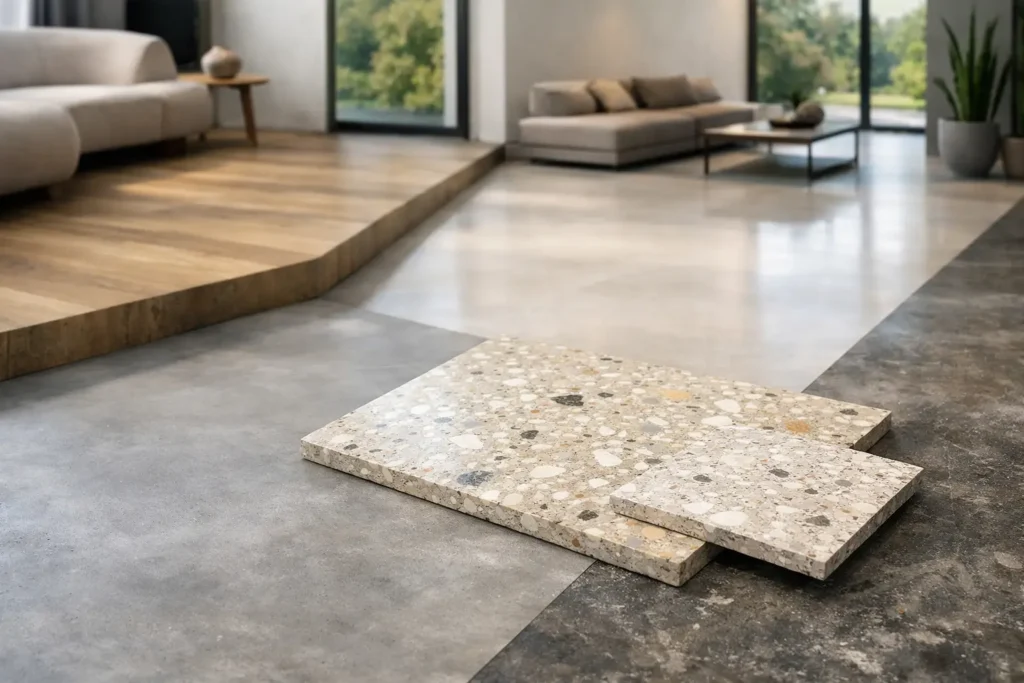
A floor no longer has to sit quietly beneath the furniture. It can set the mood of an entire room, carry a colour story from one space to the next and make everyday interiors feel considered from the ground up. The most compelling seamless flooring design trends are moving away from purely clinical finishes and towards expressive, tactile surfaces with the durability to handle real life.
For homeowners, that might mean a warm mineral-look finish flowing through a kitchen and hallway. For commercial spaces, it could mean a polished resin surface that reflects a brand’s character while standing up to heavy footfall, equipment and daily cleaning. The common thread is a desire for fewer visual interruptions and more freedom to create an interior with a clear point of view.
Seamless Flooring Design Trends Shaping Interiors
The appeal of a continuous resin floor begins with visual calm. Without tile joints, grout lines or repeated plank edges dividing the surface, a room can appear broader, cleaner and more architectural. This is especially effective in open-plan homes, compact bathrooms and retail settings where the floor needs to support the overall design rather than compete with it.
Yet the most interesting direction is not minimalism for its own sake. Current schemes pair an uninterrupted base with character: softly mottled pigments, flecks of aggregate, reflective movement or concrete-inspired variation. The result feels composed rather than plain. It offers a refined backdrop for timber cabinetry, sculptural lighting, natural stone and bold furnishings, while retaining enough detail to feel individual.
Terrazzo-Inspired Resin With a Softer Edge
Terrazzo remains a strong influence, but the look is evolving. Instead of high-contrast chips scattered across a bright white ground, many design-led projects are choosing restrained palettes: ivory with warm grey, sand with pale stone, or charcoal softened by muted mineral fragments. These combinations bring interest underfoot without making the room feel busy.
A terrazzo-inspired resin overlay also offers an opportunity to tune the scale of the pattern. Fine aggregate can create a subtle, almost cloud-like texture, while larger decorative fragments make a bolder feature for entrance halls, cafés or statement bathrooms. This level of control is valuable when the floor must complement existing finishes rather than dictate every decision in the room.
There is a practical consideration, too. A very pale, highly polished surface can show marks more readily in a busy family kitchen or commercial entrance. Choosing a gently variegated base, a mid-tone palette or a lower-sheen finish can preserve the visual impact while making day-to-day living feel less demanding.
Concrete Effects That Feel Considered, Not Cold
Concrete-effect flooring continues to appeal because it gives interiors a grounded, contemporary quality. The strongest versions are not flat blocks of grey. They have tonal movement, soft trowel marks and a depth of pigment that reads as crafted rather than imitated.
Warm greige, mushroom, clay and taupe are increasingly taking the place of cooler industrial greys. These shades work particularly well with oak, brushed brass, linen and off-white walls, creating a calm material palette that suits both period renovations and modern extensions. A concrete-inspired resin finish can bring this look into spaces where poured concrete would be impractical, including upper floors and rooms where weight, installation constraints or comfort underfoot need closer attention.
The finish level changes the effect. A matt or satin surface tends to feel more relaxed and architectural, while a glossier option reflects light and can make a darker room feel brighter. Neither is automatically better. The right choice depends on how the space is used, how much natural light it receives and whether the desired atmosphere is understated or more dramatic.
Metallic Finishes Become More Directional
Metallic resin flooring has matured beyond the high-gloss, high-drama look associated with showpiece interiors. It can still create movement and depth that no conventional covering can match, but current designs often use it with more restraint. Smoky bronze, graphite, deep ocean tones and muted pewter can create a sense of liquid stone or weathered metal without overwhelming the architecture.
This approach is particularly effective in feature spaces: a dining area, cocktail bar, reception zone, boutique retail floor or a garden room designed for entertaining. Metallic effects naturally vary across the surface, which is part of their appeal. They should be selected by clients who value artistry and individuality, rather than those seeking a perfectly uniform finish.
Lighting deserves careful thought here. Daylight reveals pigment movement differently from evening lighting, and a floor that looks subtle in a sample may become far more expressive across a larger area. Viewing samples alongside cabinetry, wall colours and metalwork helps ensure the final composition feels intentional.
Colour Is Becoming More Architectural
For years, white, pale grey and black dominated modern flooring choices. They remain useful, but the colour story is widening. Earth-led neutrals are bringing warmth to contemporary spaces, while deep colours are being used to create intimacy and visual confidence.
Olive, clay, tobacco, oxblood and inky blue can all work beautifully in the right setting. In a large, light-filled kitchen, a richer floor can anchor pale joinery and stop the room from feeling overly sterile. In a commercial environment, a deep resin surface can reinforce a premium identity and provide a memorable first impression before customers reach the counter or display.
Colour should not be chosen in isolation. The way a pigment sits beside skirting, door frames, natural light and adjacent rooms matters just as much as the colour itself. A bespoke sample process gives clients space to assess undertones and finish level before committing to a full installation, which is especially valuable with nuanced neutrals that can shift from warm to cool throughout the day.
Performance Is Part of the Design Brief
A beautiful floor needs to suit the realities of its environment. Kitchens and hallways face grit, spills and repeated traffic. Bathrooms require a finish designed for wet conditions. Garages, warehouses and workshops need coatings capable of handling more demanding use, from vehicle movement to dropped tools and regular cleaning.
That does not mean design must be sacrificed for performance. Resin systems can be specified with the appropriate build-up, protective topcoat and slip-resistance for the setting, while still delivering a tailored appearance. In a home, comfort, cleanability and visual continuity may lead the brief. In a commercial unit, chemical resistance, abrasion tolerance and safe traction may carry more weight.
Preparation is where the long-term result is often decided. The existing substrate must be assessed for moisture, movement, cracking and level before any decorative finish is applied. A striking surface cannot compensate for an unsuitable base, and responsible installers will treat this stage as essential craftsmanship rather than an afterthought.
The Return of the Feature Floor
Not every resin floor needs to run through an entire property. One of the more creative trends is using it as a defined feature: an entrance threshold, bathroom floor, utility room, stair landing or hospitality zone. This gives homeowners a chance to introduce richer colour or bolder aggregate where it will have maximum impact.
The key is making the transition feel deliberate. Resin can meet timber, tile or carpet with a clean detail, allowing different areas to have their own character while the overall interior remains coherent. This is often the right answer for period homes, where a fully continuous finish may not suit every room, or for projects balancing a limited budget with a desire for one exceptional focal point.
For properties across Essex and London, where extensions, refurbishments and compact urban layouts often demand every surface works harder, a carefully specified resin floor can create valuable visual flow without losing personality. Resinize approaches each project as a composition of colour, texture, light and daily use, not simply as an installation.
The most successful floor will not be the one that follows every trend. It will be the one that makes the room feel complete, handles the way you live or work, and still gives you a reason to look down.