
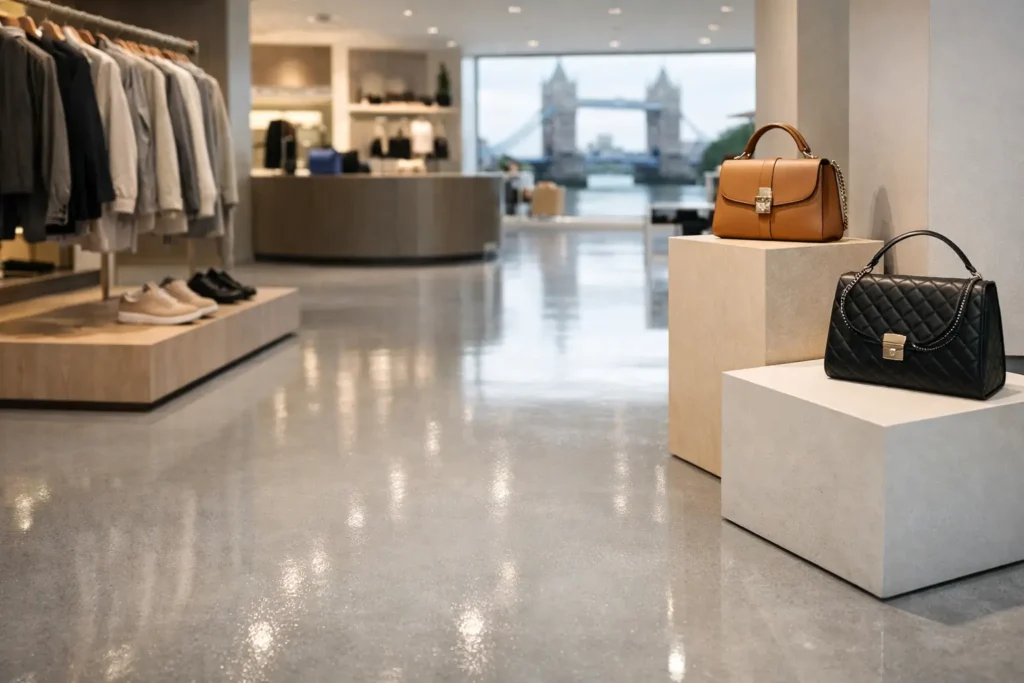
A London retail resin flooring project is rarely just a flooring decision. In a compact shop, showroom or hospitality-led retail space, the floor sits beneath every product display, every customer interaction and every changing season of footfall. It needs to look considered under bright lighting, withstand wet umbrellas and delivery trolleys, and still feel aligned with the character of the brand.
For independent retailers and established names alike, resin offers a rare balance: a practical commercial surface with the visual freedom to become part of the interior concept. The best results begin when the floor is considered early, not treated as the final layer to add once everything else has been selected.
Why a London retail resin flooring project needs a design brief
London retail interiors work hard. Entrances can see rain, grit and high pedestrian traffic in the same hour. Fixtures are moved, stock is wheeled through, and visual standards remain high because customers notice the details. A floor that scuffs quickly, traps dirt in joints or competes with the merchandise can quietly undermine an otherwise well-designed space.
Resin flooring creates a continuous surface with no grout lines or conventional tile joints. That gives a space a cleaner visual rhythm and makes daily cleaning more straightforward. More importantly, it allows the surface to support the story of the shop rather than fade into the background.
A soft concrete-effect resin can give a fashion boutique or gallery-inspired store a calm, architectural foundation. A terrazzo-inspired overlay can introduce warmth and movement to a lifestyle retailer without the weight and depth associated with traditional terrazzo. For a more expressive brief, metallic resin or decorative epoxy can produce a one-off surface with depth, tonal variation and a sense of crafted artistry.
The right choice depends on what the retail space needs to communicate. A premium skincare counter may call for a pale, refined finish that makes packaging feel elevated. A trainer store might suit a darker, tougher-looking floor with an industrial edge. A playful concept shop may benefit from colour fragments or a bespoke graphic field. The floor should frame the retail experience, not simply survive it.
Start with how the shop actually operates
A beautiful finish is only successful if it performs in the real conditions of the site. Before selecting colours or samples, consider the everyday pattern of the space: where customers enter, where queues form, where staff replenish shelves and where deliveries arrive.
The front threshold usually needs particular attention. It experiences concentrated traffic and brings in moisture and abrasive particles from the pavement. A suitable finish specification, sensible entrance matting and a maintenance routine will do more for long-term appearance than choosing a shade purely because it looks good in a sample board.
Back-of-house areas can also influence the decision. If the retail floor continues into stockrooms, staff zones or fitting-room corridors, a single resin system can create continuity while allowing practical variations in texture or slip resistance where required. In other schemes, the public-facing floor may be more decorative while service areas receive a simpler heavy-duty coating.
There is no one finish that suits every retailer. A luxury jeweller, busy salon concession and food-led shop all have different demands. The point is to make those demands visible at the beginning, when the specification can respond intelligently rather than becoming a compromise later.
Footfall, slip resistance and finish level
A glossy surface can look dramatic beneath carefully directed lighting, but it may be less forgiving of dust, marks and constant traffic than a satin or matt finish. A more subdued sheen is often a wise choice for busy retail environments because it retains a premium look while being easier to live with day after day.
Slip resistance requires the same balanced thinking. Retailers need a surface appropriate for the conditions of the premises, particularly near entrances, changing rooms or areas where spillages are possible. Yet adding texture changes the feel and cleanability of the floor. The right system considers both safety and the customer experience, rather than treating either as an afterthought.
Light changes the floor
Resin is responsive to light. Natural daylight, track lighting, window displays and warm evening illumination can all affect how a colour reads across the floor. A grey that appears quietly neutral in a studio sample may take on blue, green or warm undertones once installed alongside a particular wall finish.
This is where sample-led decision-making matters. Reviewing colours and effects against cabinetry, paint, signage and display materials helps create a more cohesive result. For decorative resin finishes, natural variation is part of their appeal, so the expectation should be a considered, bespoke surface rather than a mechanically identical pattern repeated from tile to tile.
Choosing a resin look that strengthens the brand
The strongest retail spaces have a point of view. Their materials, lighting, fixtures and floor all speak the same visual language. Resin gives designers and business owners room to develop that language with more freedom than many off-the-shelf floor coverings allow.
Concrete-effect resin suits interiors built around steel, timber, blackened metal, exposed services or restrained joinery. It offers an urban, contemporary feel without the joints, dusting or inconsistency that can come with unfinished concrete. The result can be minimal, but it should never feel cold when paired with the right lighting and materials.
Terrazzo-inspired resin is ideal where a brand needs character without visual clutter. Flecks can be selected to echo accent colours in the scheme, from understated mineral tones to more expressive combinations. It works particularly well in spaces where customers dwell, such as beauty, homeware and premium food retail, because it rewards a closer look.
Metallic and decorative epoxy finishes are more theatrical. Their movement and depth can create a memorable arrival point, a feature zone around a central display or a high-impact customer area. They are not the obvious answer for every shop. If product displays are already highly colourful or the brand depends on a quiet, editorial aesthetic, a more controlled finish may serve the space better.
Programme planning matters as much as the finish
Retail fit-outs run on tight programmes. A delayed floor can hold up joinery, merchandising, final cleaning and opening day. Resin installation therefore needs to be planned around substrate preparation, curing times, site access and the order in which other trades are working.
The condition of the existing subfloor has a major bearing on the programme. Moisture, unevenness, cracks, old adhesives and contamination may need addressing before a resin system is installed. Skipping that preparation to save time is a false economy. The visible surface may be design-led, but its longevity depends on what sits beneath it.
Early site assessment also helps determine whether the floor can be installed in phases, whether thresholds need detailing and how existing fixtures will be protected. For trading premises undergoing a refresh, phased work may reduce closure time. For a full refurbishment, the cleanest approach is often to programme resin after heavy trades are complete but before delicate display elements and final merchandising arrive.
Communication is especially valuable in central London locations, where access windows, loading restrictions and shared-building rules can shape the installation as much as the design brief. A well-managed project respects the surface, the programme and the realities of the building.
Make maintenance part of the original decision
Resin floors are valued for being straightforward to maintain, but straightforward does not mean maintenance-free. Regular removal of grit, prompt attention to spillages and suitable cleaning products protect the finish and help it retain its intended appearance.
The most useful maintenance plan is one the retail team can actually follow. If a shop has a high-traffic entrance, schedule more frequent cleaning there. If display units are regularly repositioned, use protective pads and avoid dragging heavy items across the surface. Where the floor has a specialist decorative finish, the installer should explain the appropriate care method before handover.
This is also a reason to avoid selecting a pale, highly polished floor for a site that has neither entrance protection nor a cleaning routine to match. Design ambition should be protected by practical choices, not weakened by them.
A floor that earns its place in the customer experience
Retail is increasingly about atmosphere as well as transaction. Customers remember how a space made them feel: calm, energised, curious, looked after. A well-crafted resin floor can contribute to that feeling without demanding attention at every moment. It brings continuity to a room, gives displays a stronger backdrop and signals that the business has thought carefully about its environment.
For retailers investing in a new fit-out or a considered refresh, the most productive next step is to gather material references, note the operational pressure points and view finishes in the context of the actual space. With a clear brief and precise installation, the floor can become one of the most enduring expressions of the brand.