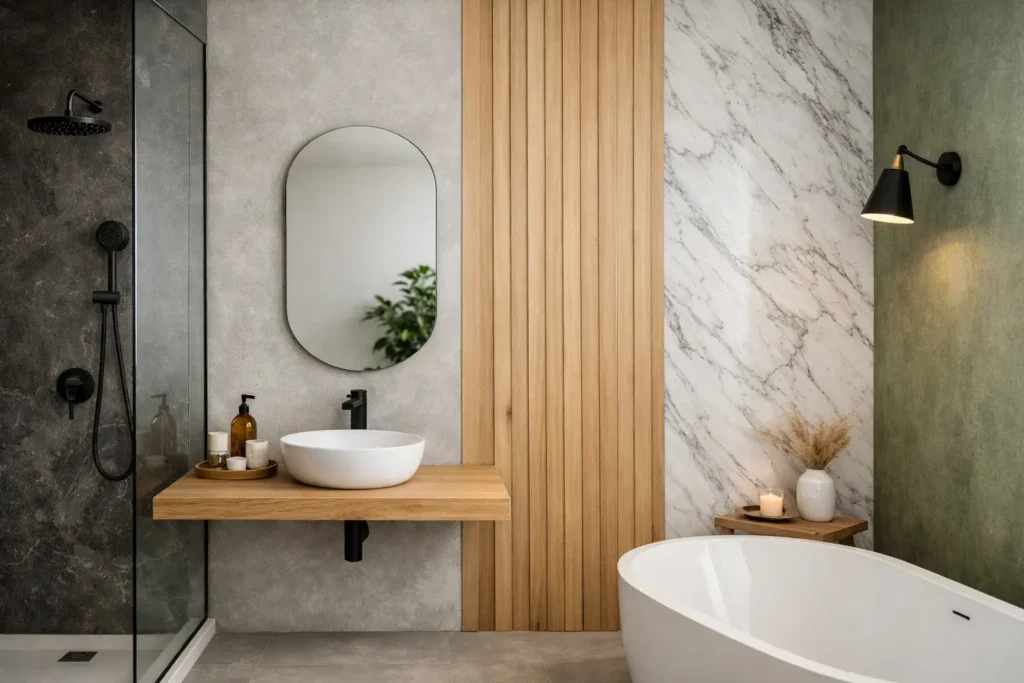
A bathroom can feel beautifully considered until the eye lands on a grid of grout lines. Tiles remain a familiar choice, but they are not the only route to a waterproof, hard-wearing finish. The best bathroom wall alternatives create a cleaner visual field, reduce cleaning, and give the room a more individual character – whether you are updating a compact cloakroom or designing a statement ensuite.
The right material depends on where it will sit. A wall directly behind a shower needs proven waterproofing and careful detailing around fittings. A wall near a basin or bath needs splash resistance. Elsewhere, you have far more freedom to prioritise texture, colour and atmosphere.
Why look beyond bathroom tiles?
Tile has earned its place for good reason: it is durable, widely available and familiar to installers. Yet the practical compromises can become apparent over time. Grout can discolour, silicone joints need periodic attention, and even a well-chosen tile can make a small bathroom feel visually busy.
Alternative wall finishes can offer a calmer, more architectural result. Large-format materials reduce joins; seamless systems remove them almost entirely. This is particularly effective in contemporary bathrooms, where uninterrupted surfaces allow brassware, lighting and joinery to take centre stage.
There is no single best material for every scheme. Budget, wall condition, ventilation, desired finish and installation expertise all matter. The following options are the strongest alternatives to consider.
8 best bathroom wall alternatives to tiles
1. Seamless resin wall finishes
For a truly continuous look, resin is difficult to match. Applied as a liquid system and finished by hand, it forms a smooth, joint-free surface that can be used across walls, floors and shower areas when specified correctly. The result is not simply practical: it makes the room feel composed as one designed space rather than a collection of separate surfaces.
Resin offers remarkable creative range. Soft concrete effects suit pared-back interiors; terrazzo-inspired finishes bring depth and movement; metallic pigments can create a more expressive feature wall. Colours can be tailored to the scheme, making it possible to carry a particular tone from vanity unit to shower enclosure without relying on an off-the-shelf tile range.
Quality preparation is essential. Resin is only as good as the substrate beneath it, and shower areas require a complete waterproofing approach before the decorative finish is applied. It is a premium, specialist-installed choice, but for homeowners seeking artistry alongside everyday durability, the visual return is considerable.
2. Decorative microcement or concrete-effect finishes
Microcement and other cement-based decorative coatings give walls a quiet, tactile appearance with subtle tonal variation. They work especially well in minimal bathrooms, where the aim is a warm, spa-like backdrop rather than a reflective or patterned surface.
A genuine wet-room specification is vital. Not every decorative plaster marketed for bathrooms is suitable for constant water exposure, so ask exactly which primer, waterproofing layer and sealers are included. A correctly specified system can work beautifully in showers; an unsuitable one may stain, crack or lose its protective finish.
The appeal lies in its imperfect character. Expect gentle movement and hand-applied variation, not the uniformity of porcelain. If that natural variation would frustrate you, a resin concrete-effect finish may provide a more controlled alternative.
3. Waterproof wall panels
Bathroom wall panels are a practical answer for renovation projects where speed and straightforward maintenance matter most. Available in PVC, acrylic and laminated composite formats, panels are generally fitted in large sheets, leaving significantly fewer joints than tiles. Many can be installed over sound existing surfaces, reducing demolition and disruption.
Their main strength is convenience. A good-quality panel is easy to wipe down, available in stone, marble, wood and solid-colour looks, and particularly useful for shower surrounds. The trade-off is authenticity: printed finishes can look less convincing at close range than a real mineral or hand-finished surface.
Choose panels with a substantial feel, reliable edge trims and a system designed for wet areas. The weakest detail is often not the panel itself but the poorly finished corner, cut-out or seal around a mixer valve.
4. Large-format porcelain slabs
Porcelain slabs retain the familiar benefits of tile while dramatically reducing visible grout lines. A single slab can cover a substantial area, creating the appearance of natural stone, polished plaster or concrete with excellent resistance to water and staining.
This option suits clients who want a precise, luxurious finish and the reassurance of porcelain. The visual scale can make a smaller bathroom appear wider and calmer, particularly when the same slab continues from wall to floor.
Installation is more demanding than conventional tiling. Slabs are heavy, require very flat backgrounds and need skilled handling to avoid chips or breakages. They also retain some joints, however minimal, so they do not deliver the completely continuous finish of resin.
5. Natural stone cladding
Natural stone brings depth that manufactured materials cannot fully replicate. Slate, marble, limestone and quartzite each carry their own mineral markings, tonal changes and tactile qualities. Used selectively, stone can turn a vanity wall or bathing alcove into a focal point with genuine permanence.
It does demand informed care. Many stones are porous and must be sealed correctly; some are better reserved for lower-splash areas. Acidic cleaners can damage certain surfaces, and pale stones may show water marks more readily than porcelain or resin.
For those willing to care for it, stone rewards the investment with singular character. It is often most successful when balanced with simpler surrounding surfaces rather than used on every wall.
6. Moisture-resistant decorative plaster
Decorative plaster can introduce warmth and softness to areas outside the shower zone. Limewash-style textures, fine mineral finishes and polished plasters offer a depth of colour that paint cannot quite achieve, making them ideal for a powder room, a wall opposite the bath or a ceiling treatment.
This is an area where specification matters more than appearance. Standard plaster is not a substitute for a waterproof wall system. Unless the finish has been designed, sealed and warranted for wet conditions, keep it away from direct spray and persistent splashing.
Used in the right location, decorative plaster brings a crafted, boutique-hotel quality to a bathroom. Pair it with simple sanitaryware and carefully chosen lighting to let the surface’s subtle movement do the work.
7. Bathroom-grade paint
Paint is the most accessible alternative and remains a smart choice for low-splash walls. Modern bathroom paints are formulated to resist humidity and mould better than ordinary emulsion, and they make changing the mood of a room relatively simple.
Paint alone is not suitable inside a shower enclosure or directly behind a bath without adequate protection. Even in a well-ventilated room, regular condensation eventually tests any coating. It is best used above a durable splashback, on upper walls, or in a cloakroom where water exposure is limited.
The design advantage is freedom. Deep green, chalky blue-grey or a warm mineral neutral can give the room personality for a modest outlay, especially when offset with a more durable feature finish around wet zones.
8. Timber-effect and real timber wall treatments
Timber can make a bathroom feel unexpectedly calm and residential. Real timber panelling, veneered boards and waterproof timber-effect panels all bring warmth to a space often dominated by cold, hard materials.
Real wood requires the greatest care. It must be properly sealed, detailed to allow for movement and kept away from sustained direct water unless a specialist system is used. Timber-effect panels offer the same visual direction with less maintenance, making them a sensible choice for family bathrooms and rental upgrades.
Consider timber on a vanity wall, behind a freestanding bath or in a well-ventilated cloakroom. In those positions, it can soften the room without being asked to perform beyond its limits.
How to choose the right finish for your bathroom
Start with the wettest area, not the prettiest sample. Decide whether you need a finish for a fully enclosed shower, a wet room, or simply the walls around a basin. Then consider the room’s ventilation. Even excellent materials benefit from an effective extractor fan and sensible aftercare.
Next, think about the visual scale you want. Panels and slabs minimise joints; seamless resin removes them; stone and plaster offer more natural variation. If easy cleaning is your priority, smooth non-porous finishes are usually the most forgiving. If the room needs warmth and texture, decorative coatings or timber may be worth the additional care.
Finally, be honest about installation. Bathrooms are high-consequence spaces: a small failure at a joint, drain, corner or penetration can create expensive problems behind the finish. Premium surfaces deserve experienced preparation and precise detailing, particularly where walls meet shower trays, floors and built-in joinery.
A thoughtful bathroom is not defined by whether it has tiles. It is defined by how its materials work together under real daily use. For a surface that feels distinctive rather than standard, Resinize can help turn that practical brief into a considered, seamless finish with lasting presence.