A commercial floor has to do more than survive footfall. It sets the visual standard the moment a customer enters, supports safe daily operations, and needs to keep its finish when trolleys, stock, spills and cleaning routines take their toll. The top commercial floor finishes balance that practical brief with an interior that feels considered rather than purely functional.
For a boutique retail unit, the right surface may become part of the brand experience. In a warehouse or garage, its value lies in resistance, cleanliness and clear working zones. The best choice is rarely the material with the longest list of claims. It is the finish that suits the space, the traffic, the cleaning regime and the atmosphere you want people to remember.
What makes a commercial floor finish work?
Commercial flooring is often specified late in a project, after lighting, joinery and furnishings have taken centre stage. That can be costly. Floor finish affects acoustics, slip resistance, hygiene, maintenance downtime and the way a space carries its identity.
Start with the operational reality. Consider whether the area receives pedestrian traffic, wheeled equipment, vehicles, moisture, oils, food spills or chemicals. Then consider what happens when the site is busy. A highly textured surface may add grip, for example, but can take more effort to clean. A pale, elegant finish can transform a showroom, but needs the right protective system and maintenance expectations in a loading area.
The substrate matters just as much. Concrete may need repair, moisture testing or preparation before any coating is applied. A beautiful finish is only as reliable as the surface beneath it, which is why careful assessment and preparation should never be treated as an optional extra.
Top commercial floor finishes to consider
Seamless epoxy resin flooring
Epoxy resin remains one of the most versatile choices for commercial interiors. Applied as a continuous system, it creates a hard-wearing, non-porous floor with no grout lines to trap dirt. This makes it particularly suited to retail spaces, commercial kitchens, workshops, back-of-house areas, garages and light industrial settings.
Its visual potential is often underestimated. Epoxy can be specified in a wide range of colours, from quiet neutrals to branded tones, and can incorporate flakes, quartz aggregate or decorative movement. For businesses that need performance without sacrificing presentation, that flexibility is a major advantage.
There are trade-offs. Standard epoxy can be susceptible to UV yellowing in areas with intense daylight, so the topcoat and system design need to reflect the location. Installation also requires controlled preparation and curing time. It is not a surface to rush, but when professionally installed it offers a crisp, durable foundation for demanding spaces.
Polyurethane resin systems
Polyurethane, often called PU, brings greater flexibility than epoxy. That characteristic can make it a strong option where slight substrate movement, thermal changes or comfort underfoot are factors. It is commonly considered for retail, hospitality, education and workspaces where people stand or walk for long periods.
A PU system can provide a refined seamless appearance with excellent resistance to wear. It can also offer more stable colour performance in sunlit areas, depending on the specification. The finish can be smooth and contemporary, or built with additional texture where slip resistance is required.
The choice between epoxy and polyurethane is not simply a matter of which is better. Epoxy is often preferred for certain heavy-duty and chemical-resistance demands, while PU may be better suited to spaces requiring flexibility and a softer feel. A professional survey helps establish the right balance.
Terrazzo-inspired resin overlays
For a reception space, café, salon, retail environment or design-led office, terrazzo-inspired resin delivers character without the fragmented appearance of traditional tiled finishes. Decorative aggregates are embedded within resin and finished to reveal a richly detailed, continuous surface.
This is flooring with presence. It can be subtle and mineral-led, with soft stone tones and fine flecks, or more expressive with bolder aggregate blends that echo a business’s palette. Because every combination is selected with the wider scheme in mind, it offers a level of individuality that off-the-shelf flooring rarely achieves.
It is best specified where visual impact is a meaningful part of the brief. A decorative resin floor can handle commercial use, but its chosen system should match the expected traffic and cleaning products. In an entrance or café, a suitable matt or satin finish may be preferable to a high-gloss surface that shows every mark.
Flake and quartz broadcast coatings
Broadcast resin systems combine a resin base with decorative flakes or coloured quartz, followed by protective coats. The result is textured, visually forgiving and highly practical. This makes them a popular fit for changing rooms, gyms, corridors, garages, workshops and service areas.
Quartz broadcast flooring is especially valuable where grip and durability are priorities. The aggregate can help create a more slip-resistant surface than a smooth resin floor, while the varied finish disguises minor marks between cleans. Decorative flakes offer a similar benefit with a different visual language, ranging from understated grey blends to more distinctive colour combinations.
Texture should be chosen thoughtfully. Greater slip resistance may be essential in wet zones, but an overly aggressive profile can make mopping harder or prove uncomfortable in customer-facing settings. The aim is controlled performance, not simply the roughest possible finish.
Polished concrete and concrete-effect resin
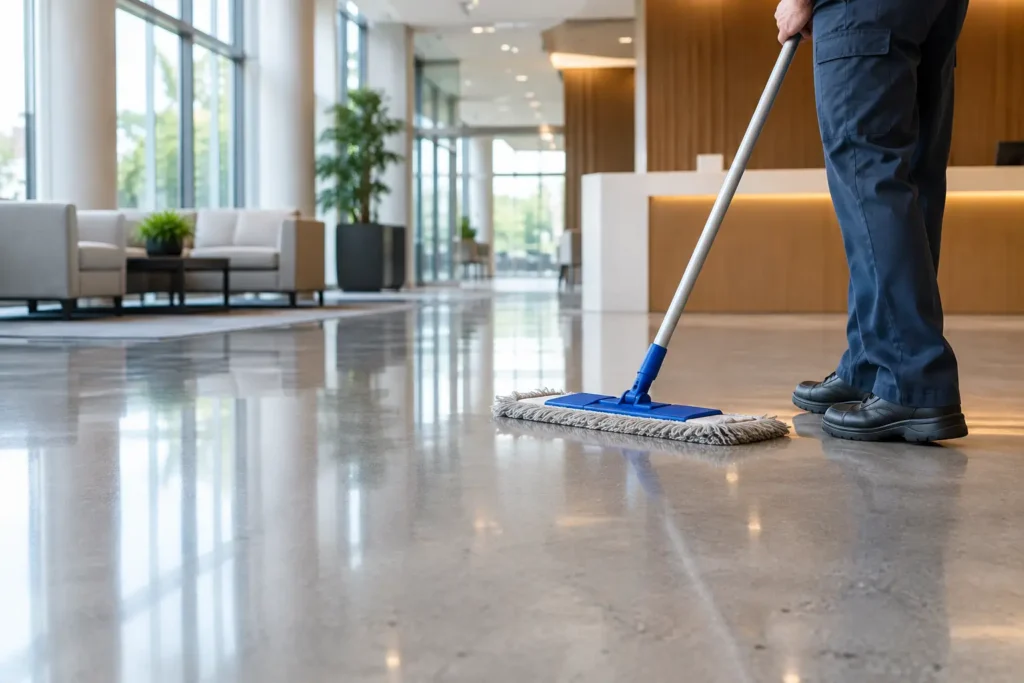
Polished concrete has a pared-back, architectural appeal that suits galleries, contemporary retail, restaurants and industrial-inspired workspaces. It celebrates the natural variation of the slab, which means it is never completely uniform. That individuality is part of its charm, but it also requires clients to embrace the marks, tonal movement and occasional imperfections inherent in concrete.
Where the aesthetic is desired but the existing slab is unsuitable, concrete-effect resin can create a similarly calm, mineral-led look. It offers more control over colour and texture while maintaining the visual continuity of a seamless finish. This can be especially useful in refurbishments where a polished concrete result is impractical.
Both options need realistic expectations. Polished concrete is not automatically stain-proof or maintenance-free, and concrete-effect resin still needs a system suited to the environment. Their strength is their restrained, crafted appearance, not an artificial promise of perfection.
Heavy-duty industrial resin coatings
Warehouses, vehicle bays, production areas and commercial garages require a more technical approach. Here, the floor needs to withstand repeated abrasion, impact, oils, tyre traffic and potentially chemical exposure. Heavy-duty resin coatings can be built in layers to meet those specific demands, with line marking and safety zoning incorporated into the finished scheme.
A well-designed industrial floor need not look utilitarian. Colour can separate pedestrian routes from operational areas, define storage locations or reinforce a company’s visual standards. A clean, professionally finished workspace supports safer movement and leaves a stronger impression on staff, visitors and clients alike.
The key is accurate specification. Point loading, forklift use, heat, contaminants and the condition of the concrete all influence the required thickness and resin type. A thin decorative coating may look smart on day one but will not replace a purpose-built industrial system.
Choosing a finish by space, not by trend
A floor that photographs beautifully may still be the wrong choice for the way a business works. In retail, a seamless decorative resin can create an immersive setting and make smaller units feel more expansive. In hospitality, hygiene, comfort and slip resistance need to sit alongside the visual concept. In kitchens and wet service zones, cleanability and safe traction take priority. In warehouses and garages, the specification should begin with the operational load, then build in colour and clarity.
Maintenance should also shape the decision. Resin floors are valued for their easy-care, grout-free nature, but every finish benefits from an appropriate cleaning routine. Use suitable products, deal with spills promptly and avoid treating the surface with harsh chemicals that are not compatible with its protective topcoat. The right daily care protects both the investment and the intended appearance.
For commercial projects across Essex and London, Resinize approaches flooring as part of the wider interior story. The most successful surfaces do not merely cover a slab. They bring together craftsmanship, performance and a finish that feels made for the business occupying the space.
A considered commercial floor is one of the few design decisions people experience with every step. Choose a finish that can handle the work, support the atmosphere and still look purposeful long after opening day.