
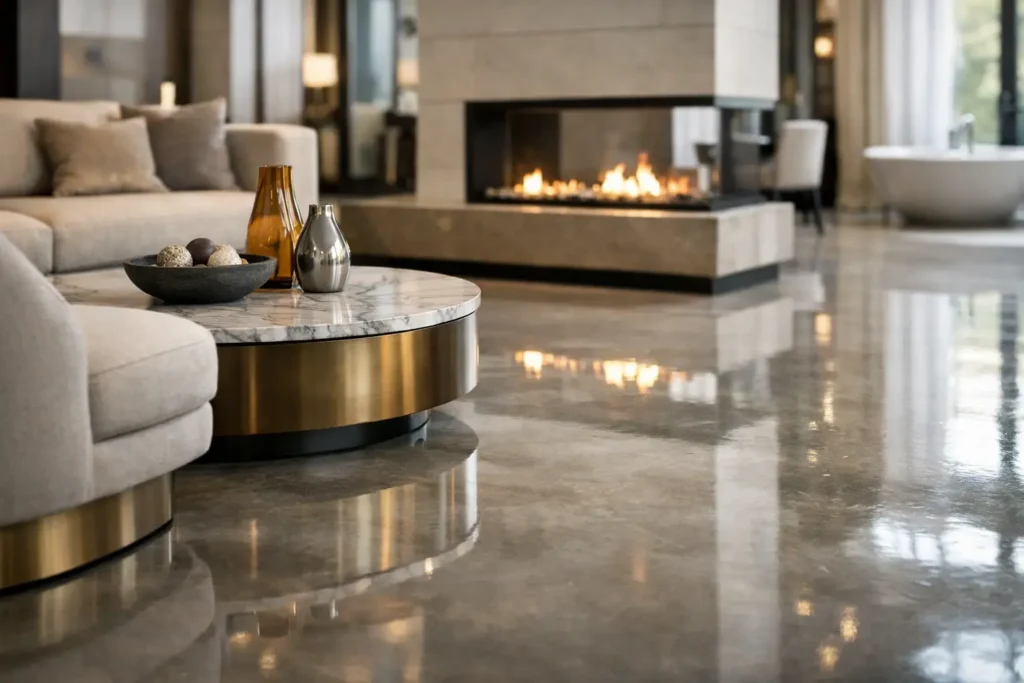
A luxury interior is often defined by what is not there: no fussy thresholds between rooms, no busy grout lines and no visual interruption beneath carefully chosen furniture. Resin flooring for luxury interiors offers that sense of calm, while giving homeowners far more creative control than many conventional floor finishes allow.
The appeal is not simply that resin looks contemporary. When designed and installed with care, it becomes part of the architecture of a room. It can carry a warm mineral tone from a kitchen into a dining space, add depth to a refined bathroom, or give an entrance hall the poised, gallery-like quality that makes the rest of a home feel considered from the first step.
Why resin belongs in a considered interior
Luxury is rarely about choosing the most expensive material in isolation. It is about proportion, finish quality and the way each surface works with light, joinery and daily life. Resin floors are poured as a continuous surface, creating a clean visual field that allows cabinetry, artwork and architectural details to take greater prominence.
That continuity is especially valuable in open-plan homes. A floor with repeated joins or competing patterns can fragment a large room. A carefully selected resin finish can do the opposite, drawing the kitchen, dining and living areas together without making them feel uniform or flat.
There is also a tactile element. Resin need not feel clinical or overly glossy. The right system can be softly matt, finely textured, clouded with gentle movement or enriched with a terrazzo-inspired aggregate. The result can feel quiet and elegant rather than showy – a surface that reveals its character gradually as daylight changes across the room.
For renovations, resin can also be an intelligent design decision where floor heights matter. In some projects, a resin overlay can be applied over an appropriate existing substrate, helping to avoid the disruption and visual compromises associated with removing every layer of an old floor. Suitability always depends on the condition of the base, moisture levels and the chosen finish, so this is a point to assess early rather than assume.
Resin flooring for luxury interiors is not one look
The phrase “resin floor” can suggest a single, highly polished aesthetic. In reality, the visual possibilities are broad. The most successful schemes start with the atmosphere a client wants to create, then select colour, movement and sheen to support it.
Soft mineral and concrete-effect finishes
For contemporary kitchens, extensions and living spaces, concrete-effect resin brings an understated, architectural character without the visual joints associated with tiled or slab finishes. Shades can range from pale chalk and warm putty to deeper stone greys, with subtle tonal variation that prevents the surface from feeling sterile.
This approach works particularly well alongside natural oak, brushed metal, linen textures and sculptural lighting. The aim is not to imitate concrete perfectly. It is to create a refined mineral finish with the warmth, consistency and practical comfort appropriate for a home.
Terrazzo-inspired resin with individual character
Terrazzo-inspired finishes offer a more expressive route. Aggregates can be selected for their scale, colour and contrast, from restrained ivory flecks in a soft neutral base to bolder compositions that echo the colours of a favourite stone, artwork or tiled splashback.
A bespoke terrazzo-style floor can become the focal point of a hallway, bathroom, bar area or garden room. It has presence, but it can still feel timeless when the palette is disciplined. In a luxury setting, the difference lies in restraint: a considered mix of tones tends to age more gracefully than a finish designed only for immediate impact.
Metallic and decorative epoxy finishes
Metallic resin is for spaces that are intended to be memorable. Its layered pigments create movement, depth and light play that cannot be repeated exactly from one installation to the next. It can suit a statement entrance, an entertaining space, a boutique retail interior or a feature wall where an ordinary painted finish would disappear.
This is not necessarily the right choice for every room. Highly active metallic effects can compete with strongly patterned furniture, elaborate joinery or veined stone. They are most convincing when the surrounding design gives the surface room to speak.
Design starts with light, not a colour chart
Samples are essential, but a sample viewed under showroom lighting is only the beginning. A resin floor responds to natural light, artificial light and the colours around it. A pale grey may read cool beside blue-toned glazing, then warmer next to oak and brass. A matt finish can absorb light beautifully in a south-facing space, while a satin sheen may bring welcome life to a darker hallway.
This is why bespoke consultation matters. Rather than selecting a colour in isolation, consider the full composition: wall tones, cabinetry, skirting details, worktops, textiles and how the room is used at different times of day. A floor covers more area than almost any other finish in the room. Small decisions in undertone or sheen have a large effect once the surface is complete.
The practical details deserve equal attention. Will a kitchen have underfloor heating? Is the room exposed to muddy shoes, pets or frequent entertaining? Are there large glazed doors that will show marks more readily in direct sunlight? These answers help determine the most suitable resin system and final texture.
Performance should feel effortless
A beautifully finished floor must earn its place in a working home. Resin is valued because it creates a continuous, easy-to-clean surface without grout lines that collect dirt or require regular attention. Spills can generally be dealt with quickly, and day-to-day care is straightforward with suitable cleaning products and a routine that protects the finish.
Durability, however, is not a licence to be careless. Like timber, stone and high-quality lacquered joinery, resin benefits from sensible use. Grit brought in from outdoors can act abrasively over time, so entrance mats are worthwhile. Heavy furniture should be moved with care, and felt protectors are a small but useful precaution beneath chairs and tables.
The finish level should be chosen honestly. A very high-gloss dark floor can look striking, but it will reveal dust, footprints and light reflections more readily than a lighter, matt or softly satin surface. For a busy family kitchen, a nuanced mid-tone with a refined low-sheen finish is often the more liveable expression of luxury.
The installation is part of the finish
Resin rewards precision. The final appearance depends not only on pigment and product selection, but on substrate preparation, moisture assessment, repair work, application conditions and curing time. A beautiful sample cannot compensate for an unsuitable base or a rushed installation.
This is one reason premium resin work should be treated as a craft process rather than a quick flooring swap. Existing cracks, movement and levels need to be understood before the decorative layers are planned. The programme must also account for preparation and curing, particularly where other trades are still active on site.
For homeowners refurbishing a property in Essex or London, coordinating resin installation around joinery, decorating and kitchen fitting can protect the finished surface from avoidable damage. The best time to plan the floor is early in the design process, even if the application takes place later. That allows thresholds, floor levels and transitions to be resolved with intention.
A surface with a point of view
The most compelling luxury interiors do not rely on generic finishes. They make room for materials that carry both visual confidence and everyday practicality. Resin can be subtle enough to support a calm, carefully layered home, or expressive enough to become the feature that defines a room.
At Resinize, the focus is on crafting those possibilities through finish samples, considered colour choices and meticulous application. The right resin floor should not merely fill the space beneath your feet. It should make the entire interior feel more resolved, more personal and more distinctly yours.