
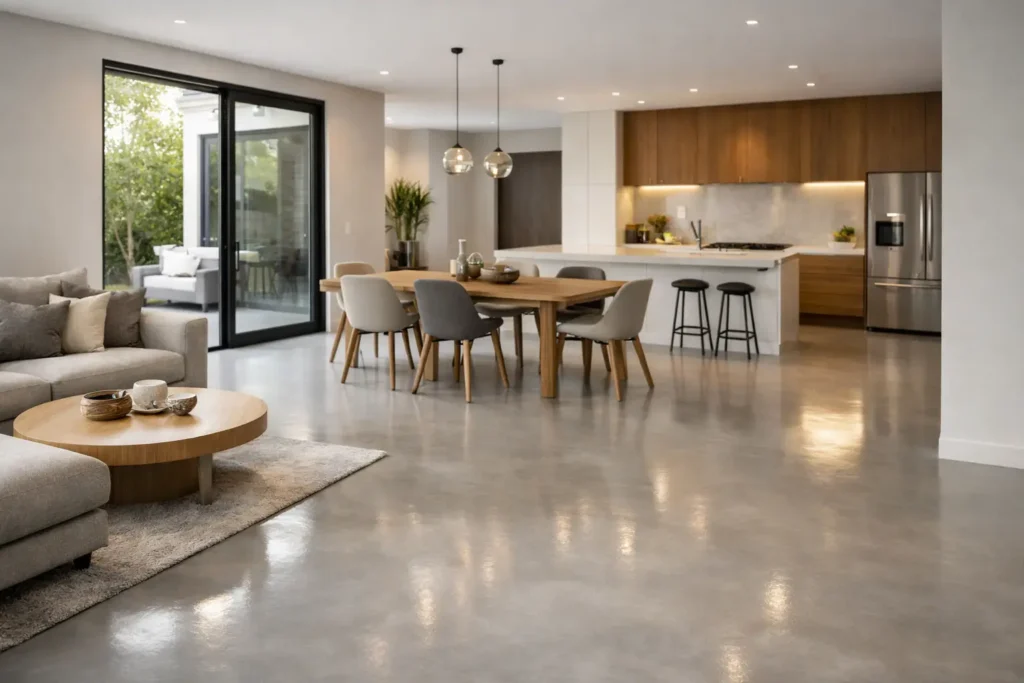
Open-plan living looks effortless when it works. Kitchen, dining area and lounge all feel connected, light moves cleanly through the space, and nothing interrupts the overall design. The floor does a surprising amount of that work, which is why resin flooring for open plan homes has become such a compelling choice for homeowners who want continuity without compromising on practicality.
Unlike a room-by-room flooring approach, resin allows the space to read as one considered interior. There are no thresholds breaking up sightlines, no awkward material changes between cooking, dining and relaxing zones, and no grout lines or plank joints pulling attention away from the architecture. The effect is modern, but not cold by default. It depends entirely on how the finish is designed.
Why resin flooring suits open-plan layouts
Open-plan homes ask more of a floor than traditional layouts do. It has to deal with heavier footfall, shifting light, furniture movement, kitchen spills and the visual pressure of being seen all at once. A floor in a smaller enclosed room can hide behind walls and doors. In an open-plan scheme, it becomes one of the most dominant surfaces in the home.
That is where resin stands apart. Its seamless finish creates visual calm, which is especially valuable in busy family spaces where cabinetry, lighting, furniture and glazing already bring plenty of detail. A continuous surface can make a large footprint feel more resolved and more architectural.
There is also a practical advantage to that uninterrupted finish. Cleaning is simpler when there are no joints to trap dirt, crumbs or moisture. For households with children, pets or regular entertaining, that ease of maintenance quickly becomes part of the appeal.
The design value of a continuous surface
A well-designed open-plan interior needs balance. You want each zone to feel purposeful, but you do not want the room to feel chopped up. Resin supports that balance beautifully because it links the whole space while still allowing other elements to define how each area functions.
An island can mark out the kitchen. A dining table and pendant lighting can establish a social centre. Sofas, rugs and joinery can shape the living area. The floor stays consistent beneath all of it, which gives the interior a quieter, more confident foundation.
This is often where homeowners rethink what flooring can do. Rather than being a background material chosen purely for durability, resin becomes part of the overall design language. Soft concrete-effect tones can create a calm contemporary base. Warmer mineral shades can make a large room feel more grounded. More decorative finishes can add subtle movement and depth without overwhelming the scheme.
Resin flooring for open plan homes is not one look
One of the most persistent misconceptions about resin is that it only suits ultra-minimal interiors. In reality, resin can be tailored to a wide range of aesthetics, from crisp architectural spaces to softer homes with natural textures and layered furnishings.
The finish matters. A matte or satin resin floor tends to feel more understated and residential, while high-gloss options make more of a statement and reflect light dramatically. Colour choice is equally important. Pale greys and warm stone tones remain popular because they work with timber, black accents, muted cabinetry and natural fabrics. But there is room for bolder design too, especially in homes where the floor is intended to be a feature rather than a backdrop.
Terrazzo-inspired resin overlays can bring character and detail into an open-plan setting without introducing separate materials. Metallic effects can create a more expressive, design-led feel, though they are usually better suited to clients who want the floor to lead the room rather than quietly support it. The right choice depends on the architecture, the light and how you want the space to feel day to day.
Where resin works best in an open-plan home
The obvious setting is the combined kitchen, dining and living area, but resin often performs just as well when the open plan extends into adjoining spaces such as hallways, utility areas or garden rooms. Carrying the same finish further through the ground floor can strengthen the sense of flow and make the home feel larger and more composed.
That said, continuity should still be intentional. In some properties, it makes sense to keep the resin within the main shared living zone and transition to another material in more private spaces. Bedrooms, for example, often call for a different tactile quality underfoot. Open plan does not automatically mean one finish everywhere.
The best outcomes usually come from reading the home as a whole. Ceiling height, natural light, heating setup, subfloor condition and how the family actually uses the space all influence whether resin is the strongest option.
Practical considerations before you choose resin
A beautiful result starts well before the final topcoat. Subfloor preparation is critical, particularly in larger open-plan areas where any imperfections can affect the finished look. If the base is uneven, cracked or unstable, those issues need to be addressed properly.
This is also why resin is not a product to judge purely by appearance in photographs. The craftsmanship behind the installation matters just as much as the colour or finish. In a large uninterrupted room, poor detailing is harder to hide. Good installation, by contrast, gives the floor that refined, effortless quality people tend to notice without immediately understanding why.
Underfloor heating often comes into the conversation too. Many open-plan homes use it, and resin can work very well with it when the system and subfloor are suitable. The key is making sure the specification is right from the outset. Open-plan renovations often involve several trades and moving parts, so coordination matters.
Then there is the question of wear. Resin is durable, but not indestructible. Like any premium finish, it performs best when matched to the demands of the environment. A family kitchen with daily use, pets and regular entertaining may need a different specification from a lightly used extension designed primarily as a calm entertaining space.
The trade-offs worth knowing
Resin offers a strong mix of beauty and performance, but it is not a one-size-fits-all answer. If you love the visual texture of natural timber planks or the crafted irregularity of stone tiles, a completely seamless floor may feel too restrained. Some clients want that clean visual field. Others prefer more visible pattern and material variation.
There is also a sensory element. Resin can feel sleek and contemporary underfoot, which many homeowners love, but comfort often comes from how the wider interior is dressed. Upholstery, rugs, curtains and timber details all play a part in softening the overall feel.
Budget is another honest consideration. A bespoke resin floor is a design finish, not a bargain-bin flooring shortcut. The value comes from its visual impact, customisation, longevity and the skill involved in getting it right. For homeowners investing in a considered open-plan interior, that can make complete sense. But it should be approached as a quality architectural surface rather than a quick cosmetic fix.
How to make the floor feel warm, not stark
The most successful open-plan resin interiors understand contrast. A seamless floor creates clarity, but the room needs layering to feel lived in and inviting. That might mean oak joinery, linen upholstery, brushed metal details, sculptural lighting or softer tonal shifts in paint and textiles.
Natural light has a huge influence as well. In bright rear extensions and larger kitchen-living spaces, resin can amplify that sense of openness beautifully. In darker layouts, the finish and colour need more thought. Lighter tones can help lift the room, while a very dark resin may feel dramatic but also more visually dominant.
This is where samples and real-site decisions matter. What looks perfect in a showroom or on a mood board can shift once it sits alongside your cabinetry, wall colours and changing daylight.
A design-led choice, not just a practical one
For homeowners who care about finish quality, proportion and atmosphere, resin flooring offers something many standard flooring options cannot. It simplifies the visual language of an open-plan home while still allowing enormous freedom in tone, texture and style. It can be quietly elegant, boldly expressive, or somewhere in between.
That design flexibility is a major part of the appeal. A bespoke resin surface is not simply fitted into a home. It is considered as part of the architecture of the space, responding to scale, light and use in a way that feels deliberate.
For design-conscious homes across Essex and London, that level of thought is often what turns a renovation from functional to memorable. Resinize approaches these projects with exactly that mindset – treating the floor as a crafted surface that shapes how the whole space is experienced.
If you are planning an open-plan scheme, think beyond what the floor needs to survive. Think about what it could contribute. The right surface does more than connect rooms – it gives the entire space its rhythm.