
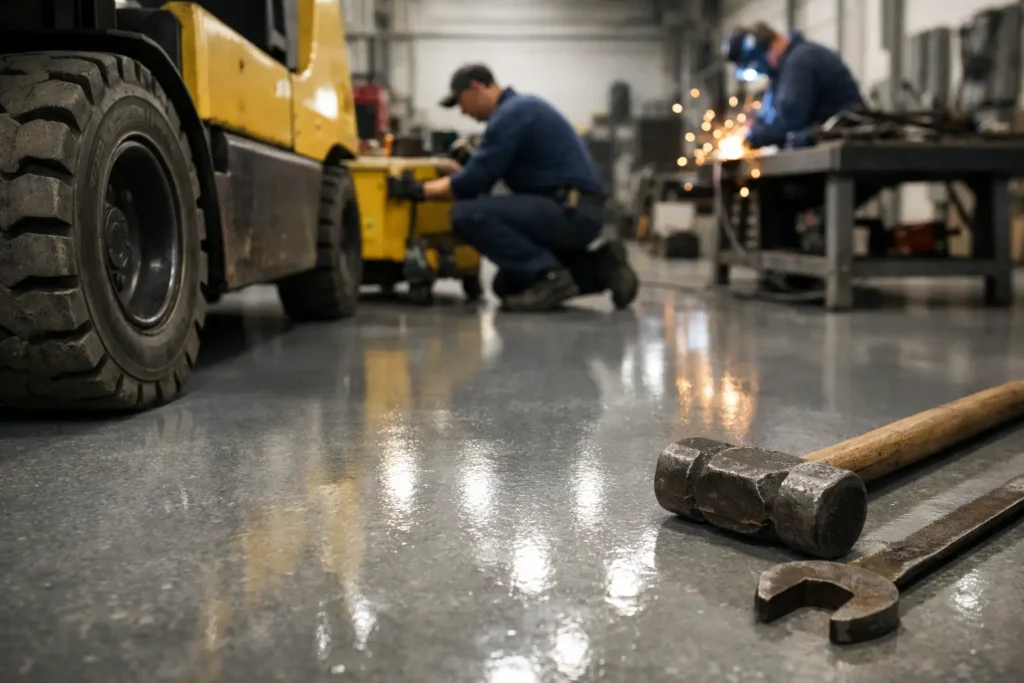
A warehouse floor that powders under forklift traffic, a garage marked by tyre heat, or a commercial kitchen with stained grout lines all face the same problem: the surface is working harder than it was designed to. Heavy duty epoxy floors offer a considered answer, creating a continuous, hard-wearing finish that can be specified for demanding use without accepting an anonymous industrial look.
For property owners and commercial teams, the appeal is not simply toughness. A well-designed epoxy floor brings order to a space. It removes joints that collect dirt, reflects light more cleanly than tired concrete, and can carry a brand colour, a refined neutral tone or a decorative finish with real confidence. The result should feel as purposeful as it performs.
What makes a heavy duty epoxy floor different?
Not every resin floor is intended for the same level of use. Decorative resin may be an excellent choice for a feature hallway, retail area or contemporary kitchen, but high-load settings require a system built around the realities of impact, abrasion, chemicals and regular cleaning.
A heavy duty epoxy floor is usually formed from multiple compatible layers. The concrete is prepared, repairs are completed, a primer is applied, and the epoxy build-up is selected to suit the site. Depending on the requirement, this may include a self-levelling body coat, a broadcast aggregate layer for added grip and wear resistance, and a protective seal coat.
The important distinction is specification. Thickness alone does not guarantee performance. A loading bay receiving pallet lorries needs a different solution from a showroom with heavy footfall, just as a food preparation area needs more considered slip resistance than a private garage. The best floor is not the one with the most material in it. It is the one designed around how the space will actually be used.
Where heavy duty epoxy floors make sense
Epoxy is particularly effective where the existing substrate is sound but visually tired, difficult to clean or vulnerable to ongoing wear. Warehouses, workshops, garages, plant rooms, retail stock areas and commercial kitchens are common applications, but the finish also has a place in design-led spaces that need commercial-grade resilience.
In a garage, an epoxy system can transform bare concrete into a clean, durable surface that stands up to tyres, tools and occasional oil spills. In a retail environment, it can create an uninterrupted backdrop that supports the interior scheme while coping with daily foot traffic and moving displays. For industrial units, the practical benefits are clear: less dust from deteriorating concrete, easier cleaning and a more professional impression for staff, visitors and clients.
There are limits, and they matter. Epoxy is not a cure for a failing slab, persistent rising moisture or major structural movement. External areas exposed to strong UV light may also require a more suitable topcoat, as some epoxies can amber or chalk over time. Honest advice begins with the substrate and environment, not a colour chart.
The floor beneath the finish decides the outcome
Concrete preparation is where a long-lasting resin installation is won or lost. A surface can look dry and solid while holding contaminants, weak laitance or moisture that prevents the coating from bonding correctly. Paint residues, oils, curing compounds and loose material all need addressing before resin is introduced.
Professional mechanical preparation opens the concrete and creates the correct profile for adhesion. Cracks, holes and damaged joints are then repaired with appropriate materials. Moisture testing is equally valuable, particularly on ground-floor slabs and older buildings where damp can travel through the concrete over time.
This work is rarely the dramatic part of a project, but it is craftsmanship in its most practical form. A flawless finish depends on what cannot be seen once the floor is complete.
Choosing performance without losing the design
The phrase ‘heavy duty’ can suggest a flat grey factory floor. It need not. Resin allows performance and visual identity to sit in the same specification.
Solid colours remain a powerful choice for commercial interiors. Charcoal, warm grey, off-white and deep tones can define circulation zones, complement shelving and fixtures, or give a workshop a sharper, more intentional feel. Flake systems introduce texture and variation, helping disguise day-to-day scuffs while creating a finish with more visual depth. Quartz aggregate can provide an especially durable, slip-conscious surface for areas where grip is a priority.
For customer-facing environments, the finish should support the wider architecture. A boutique retail unit may benefit from a restrained, polished tone rather than an overtly industrial coating. A car showroom or premium garage may call for a darker floor with subtle texture and a controlled sheen. At Resinize, the conversation begins with the way a space should feel as well as the demands it must withstand.
Gloss level deserves the same attention. High gloss can make a room brighter and more expansive, but it may show marks more readily and can be unsuitable where slip resistance is central. Satin and matt finishes feel quieter and can be more forgiving in busy working areas. There is no universal right choice – only a finish that aligns with the lighting, cleaning routine, traffic and desired aesthetic.
Slip resistance is a balance, not a checkbox
A smooth seamless floor is easy to clean, but a floor that becomes slippery when wet is not fit for every setting. This is why aggregate and texture are introduced where needed.
More texture generally improves grip, especially around entrances, wash-down zones and areas exposed to oils or water. The trade-off is maintenance: a heavily textured surface can hold more dirt and require a more deliberate cleaning regime. In a dry warehouse aisle, a gentler profile may be entirely appropriate. In a commercial kitchen or active workshop, a more structured finish is often the wiser decision.
The right approach is to assess the likely contaminants, footwear, cleaning methods and route of travel. A specification should respond to real behaviour on site, rather than relying on a generic promise of being ‘non-slip’.
Maintenance that protects the finish
Heavy duty epoxy floors are straightforward to maintain, but they are not maintenance-free. Regular sweeping removes abrasive grit that can dull any coating over time. A suitable neutral cleaner and a soft brush or scrubber will deal with routine soil without attacking the surface.
Harsh solvents, strongly alkaline cleaners and improvised chemical products should be used carefully, if at all. Spillages should be dealt with promptly, particularly oils, fuels and staining materials. Even where a coating has good chemical resistance, leaving contaminants to sit for extended periods is an unnecessary risk.
Mechanical abuse also deserves practical controls. Metal-edged equipment, dropped tools and overloaded point loads can damage a resin system just as they can damage concrete. Protective pads beneath static machinery, sensible wheel selection for trolleys and clear movement routes all help preserve the surface.
Over time, areas receiving concentrated traffic may benefit from a refresh coat. This is not a failure of the floor. It is a sensible way to renew appearance and protection before wear reaches the layers below.
Questions to resolve before specifying epoxy
The most useful brief is specific. Consider what moves across the floor, how often it is cleaned, whether water or chemicals are present, and whether the space must stay operational during the works. Programme matters: epoxy systems need appropriate conditions and curing time, so a rushed installation can create avoidable compromises.
It is also worth deciding where visual consistency matters most. If a floor continues from a back-of-house area into a public-facing space, a coordinated palette can make the whole property feel more considered. If the priority is function, zoning through colour or texture can make routes and work areas clearer without adding separate materials or joints.
A sample-led discussion is especially valuable for bespoke projects. Resin can look different under daylight, warm retail lighting and the hard illumination of a workshop. Seeing the tone, texture and sheen in context turns an abstract specification into a confident design decision.
The strongest floors do more than survive the work placed upon them. They bring clarity, character and a sense of care to the spaces where real work happens every day.