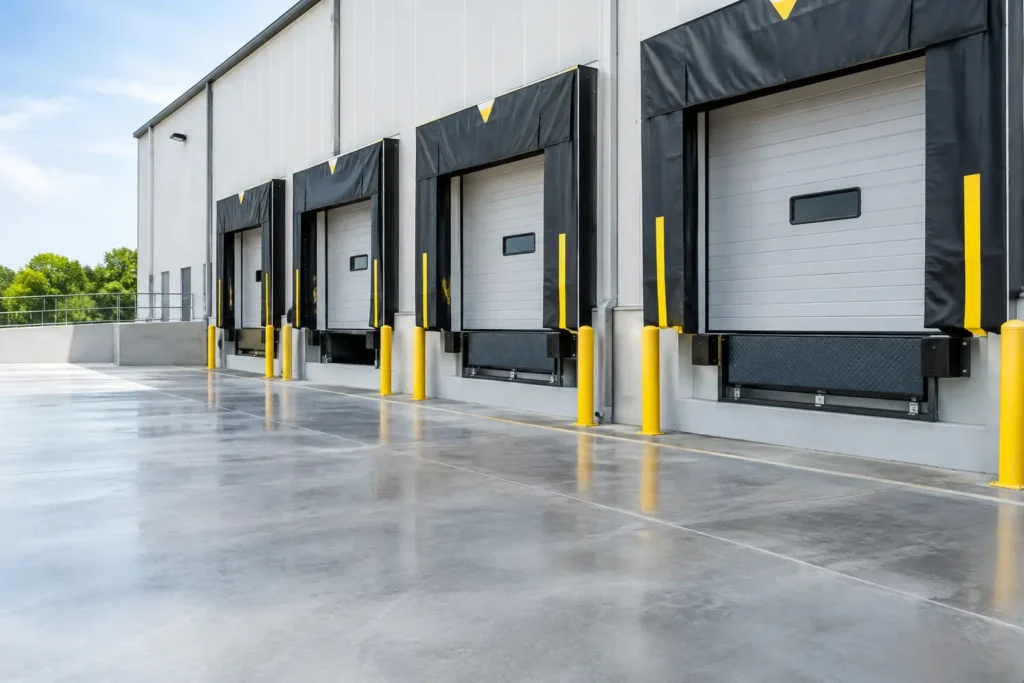
A loading bay floor earns its finish the hard way. Forklift tyres pivot under load, pallet lorries score the surface, lorries bring in water and grit, and spillages rarely arrive at a convenient moment. The best coatings for loading bays are not simply the hardest products on paper. They are systems selected around the traffic, temperatures, cleaning regime and condition of the concrete beneath them.
A well-specified resin floor can turn a tired operational area into a cleaner, safer and more considered working environment. It also reduces the dusting, staining and patchwork repairs that make a busy site look neglected. The key is choosing performance that suits the reality of the bay, rather than applying a generic warehouse coating and hoping for the best.
What a loading bay coating needs to withstand
Loading bays sit between internal and external conditions. Even covered bays are exposed to moisture blown in by the weather, grit carried on wheels and rapid temperature changes when roller shutters are open. In food, manufacturing or distribution settings, they may also face oils, detergents, dropped goods and frequent washdowns.
This creates a different brief from a standard office, retail or light-use warehouse floor. The coating needs strong adhesion to the concrete, resistance to impact and abrasion, and a texture that offers confident footing without becoming impossible to clean. It must also work with the site’s operational timetable. A brilliant finish that needs a week of closure may be impractical for a bay receiving deliveries every day.
Appearance still has a role. Clear bay markings, colour-zoned pedestrian routes and a consistent finish can make an industrial space feel more organised and professionally managed. In customer-facing trade counters or premium commercial settings, the floor contributes to how the entire operation is perceived.
The best coatings for loading bays, compared
There is no universal winner. A coating that performs beautifully in a dry distribution centre may fail prematurely at a chilled goods entrance or an exposed loading apron. These are the principal options worth considering.
Heavy-duty epoxy resin systems
Epoxy remains a strong choice for enclosed loading bays with demanding vehicle traffic. Applied as a high-build coating or a thicker resin screed, it creates a dense, non-porous surface that stands up well to abrasion, oils and many common chemicals. It is available in practical colours, can incorporate anti-slip aggregate, and gives concrete a clean, unified appearance.
For sites wanting a polished operational finish, epoxy is often the most versatile starting point. It can be colour matched to support wayfinding, safety zones or a wider interior palette. Its limitation is environmental exposure. Standard epoxy can yellow or chalk under sustained ultraviolet light, and it is less forgiving where thermal shock, persistent damp or significant substrate movement are present.
Polyurethane cement systems
Polyurethane cement, often called PU cement, is one of the most capable choices for severe loading bay conditions. It is especially suited to areas subject to hot and cold temperature changes, repeated washdowns, food processing activity or chemical exposure. Its cementitious composition also makes it more tolerant of damp concrete during installation than many conventional resin systems.
This comes at a higher initial cost and may offer a more industrial visual character than a decorative epoxy finish. Yet where performance and longevity are the priorities, PU cement can represent better value over the life of the floor. It is particularly effective around chilled storage, commercial kitchens, production thresholds and high-traffic delivery areas.
Polyaspartic coatings
Polyaspartic systems are valued where programme pressure is high. They can cure far faster than traditional epoxy, allowing some floors to return to service within a short window, subject to the system and site conditions. They also provide strong UV stability, making them useful for loading bays with open elevations or areas that continue outdoors.
The speed of cure demands experienced installation. Preparation, mixing and application must be carefully controlled, particularly in changing temperatures or humid conditions. Polyaspartic coatings can be an excellent solution for fast-turnaround commercial work, but they are not a shortcut around proper concrete repair and moisture management.
Methyl methacrylate coatings
Methyl methacrylate, or MMA, is another rapid-curing resin option. It can be installed in colder conditions than some alternatives and is useful where downtime must be kept to an absolute minimum. For certain 24-hour operations, that advantage can be decisive.
Its distinct installation odour needs managing, especially near occupied spaces or sensitive stock. MMA should therefore be chosen with the wider building environment in mind, not only the floor’s mechanical demands.
Anti-slip performance is a balancing act
A loading bay needs grip where people step down from vehicles, manoeuvre pallet trucks or walk across wet entrances. But an aggressively textured finish can trap dirt, make wheeled handling harder and demand more intensive cleaning. The right anti-slip profile depends on how the bay is used.
Fine aggregate is often enough for a covered bay with occasional moisture. A coarser broadcast finish may be more suitable for a washdown area, external threshold or location where rain and contaminants are routine. The most successful specifications target texture where it is needed rather than applying the same heavy profile across every square metre.
Safety markings should be considered as part of the resin system, not added as an afterthought. Clearly defined pedestrian lanes, loading zones, hazard areas and door thresholds help direct movement and preserve the surface’s visual order. When integrated professionally, they remain crisp and far more durable than loosely applied paint.
Preparation determines how long the coating lasts
Even the highest-quality resin cannot compensate for weak, contaminated or moving concrete. Before selecting a finish, the substrate should be assessed for laitance, old coatings, oil penetration, cracking, moisture and uneven levels. Mechanical preparation, usually through diamond grinding or shot blasting, creates the clean profile needed for reliable adhesion.
Cracks are not all the same. Static cracks can often be repaired and bridged within an appropriate resin build-up. Movement joints need a different approach. They should normally be honoured and filled with a flexible joint material, because coating straight over active movement is likely to lead to a visible failure line.
Moisture is equally important. Ground-floor slabs without an effective damp-proof membrane can allow vapour pressure to push against the new finish. In these cases, a compatible moisture-tolerant primer or damp-control system may be required. Skipping this stage to reduce cost can result in blistering or debonding later.
How to choose the right system for your site
A useful specification begins with a site survey rather than a colour chart. The installer should understand the weight and frequency of vehicle movements, whether forklifts use solid or pneumatic tyres, how often the bay is washed, the likelihood of chemical spillages and the time available for installation.
It is also worth considering the edge conditions. Roller shutter thresholds, drainage channels, dock levellers and external aprons are common pressure points. Water should move towards drains, not sit beneath pallets or pool at entrances. Where the existing falls are poor, local repairs or a resin screed may be needed before the final coating is laid.
For a dry, enclosed bay with regular forklift traffic, a high-build epoxy system with a measured anti-slip finish is often a sensible balance of durability, appearance and cost. For wet, temperature-variable or hygiene-critical settings, polyurethane cement may be the better long-term answer. Where closure time is the overriding concern, polyaspartic or MMA systems deserve a closer look.
A finish designed around the work, not just the floor
The most effective loading bay floor does not ask your operation to work around it. It supports safer movement, simpler cleaning and a more professional setting from the first delivery of the day to the last. At Resinize, that means treating commercial resin flooring with the same care for detail, finish and lasting performance as any design-led surface.
Before committing to a coating, ask for a specification that explains the preparation, resin build-up, anti-slip grade, curing window and treatment of joints and thresholds. That conversation is where a loading bay stops being an overlooked concrete space and becomes a surface built for the work ahead.