
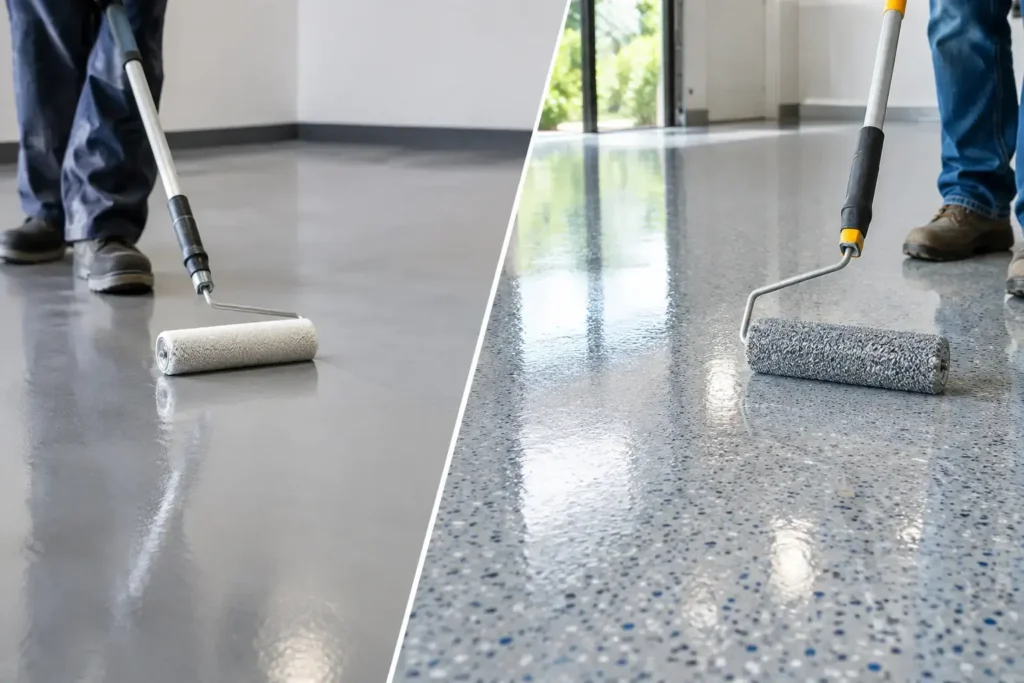
A resin floor can make a kitchen feel composed, turn a retail space into part of the brand experience, or give a hard-working garage a finish that looks considered rather than purely industrial. Yet the choice between urethane versus epoxy is rarely as simple as choosing one material over the other. The right result depends on how the space is used, the light it receives, the design you want to achieve and the condition of the substrate beneath it.
For many projects, epoxy and urethane work best as part of the same carefully specified floor system. Understanding their different strengths helps ensure the finished surface feels as good in daily life as it does on installation day.
Urethane versus epoxy: the essential difference
Epoxy is a resin coating valued for its strength, adhesion and design versatility. It bonds exceptionally well to correctly prepared concrete and can be built into decorative, metallic, terrazzo-inspired and heavy-duty floor finishes. It is often the material that creates the depth, movement and character people associate with premium resin flooring.
Urethane, more commonly called polyurethane in flooring specifications, is generally more flexible than epoxy. It is highly resistant to scratching, scuffing and many forms of everyday wear. Aliphatic polyurethane coatings also offer strong UV resistance, helping a floor retain its intended colour where daylight is a major feature of the space.
That does not make urethane automatically superior, nor does it make epoxy the default answer for every setting. Epoxy is often the structural and decorative foundation; urethane may be the protective finishing layer. In other projects, a polyurethane system may be specified for its particular performance characteristics. The best decision is about the complete build-up, not a simplistic material contest.
Appearance: depth, colour and creative freedom
For homeowners planning a statement kitchen, hallway or garden room, epoxy often offers the widest creative canvas. Decorative flakes, coloured aggregates, marble-like movement and metallic effects can all be formed within an epoxy resin layer. It can create an understated concrete-effect surface or a bolder, light-catching floor with real visual presence.
Epoxy’s clarity and depth are especially valuable when the design relies on layered detail. Terrazzo-inspired finishes, for example, need carefully placed aggregates and a refined surface that allows the composition to read clearly. A skilled installation team can adjust colour balance, aggregate size and sheen so the floor sits naturally within the wider interior scheme.
Urethane is usually chosen less for dramatic decorative depth and more for the protection and final character it brings to the surface. Available in matt, satin and gloss finishes, it can soften a highly reflective look or preserve a polished finish while improving durability. This final sheen matters. A matt floor can feel calm and architectural, while a satin or gloss finish can amplify light and make colours appear richer.
Where epoxy performs best
Epoxy is a compelling choice where adhesion, compressive strength and a visually distinctive finish are central to the brief. Warehouses, workshops, garages and retail settings often benefit from its ability to create a hard, cleanable surface that can tolerate demanding use when correctly designed and installed.
In residential interiors, epoxy is equally valuable where a continuous, design-led finish is wanted across open-plan spaces. Unlike tile layouts with visible joints, resin can create an uninterrupted visual field that allows furniture, lighting and joinery to take centre stage. It is a particularly effective partner for contemporary interiors, where a floor should feel integral to the architecture rather than like a separate layer.
There are trade-offs. Standard epoxy can yellow or change tone when exposed to prolonged sunlight, particularly in rooms with large south-facing glazing. It is also comparatively rigid. If the substrate moves, cracks or is affected by moisture, the floor system must be selected and prepared with care. A beautiful resin finish cannot compensate for poor groundwork.
Where urethane has the advantage
Urethane performs particularly well in spaces exposed to sunlight, frequent footfall and regular abrasion. Its flexibility can make it more forgiving than epoxy under certain movement conditions, while its resistance to scuffs is valuable in busy homes, hospitality settings and commercial spaces where appearance needs to hold up over time.
UV stability is one of its clearest advantages. In a bright extension, showroom or glazed entrance, an aliphatic urethane topcoat can help protect the underlying decorative epoxy from discolouration. This makes it a considered addition where preserving a pale neutral, crisp white or carefully chosen colour palette is essential.
Urethane also tends to offer a more comfortable, less brittle feel underfoot than a purely epoxy finish, although the difference will depend on the overall specification and thickness of the system. For projects where people stand for long periods, such as kitchens, salons or service counters, that added resilience can be worthwhile.
Its limitations should be acknowledged too. Urethane is not always the ideal standalone decorative base for every bespoke finish, and it can be less forgiving during application. Temperature, humidity, preparation and timing all influence the final outcome. This is why resin flooring should be treated as a specialist craft, not a product to select from a colour chart alone.
The strongest answer is often a combined system
For many premium floors, the most effective approach is epoxy beneath urethane. The epoxy layer provides adhesion, build and decorative opportunity; the urethane topcoat provides a protective surface with enhanced scratch and UV resistance. Together, they create a floor designed around both visual impact and real-life use.
A boutique retail floor might use a decorative epoxy base to establish the brand’s palette, followed by a urethane finish selected for scuff resistance. A family kitchen could use a terrazzo-inspired epoxy overlay with a satin urethane topcoat, giving the space character without making daily maintenance feel precious. In a garage, a heavier-duty epoxy build may be paired with a protective top layer chosen for tyre traffic, oils and cleaning routines.
The specification should always respond to the environment. Direct sunlight, underfloor heating, existing cracks, moisture levels, anticipated traffic, cleaning chemicals and slip-resistance requirements all affect the right recommendation. A resin floor is at its best when the material is working with the building, not being asked to ignore its conditions.
Choosing for homes, garages and commercial spaces
In a home, visual comfort is often the starting point. Consider how the finish will look in changing daylight, against cabinetry and walls, and with the natural marks of family life. A pale matt surface may suit a relaxed, contemporary kitchen, while a deeper metallic effect can transform a cloakroom, bar area or feature room into something more theatrical.
For garages and workshops, performance questions take priority. Will the floor receive vehicle traffic? Are oil, brake fluid or chemical spills likely? Is the concrete sound, dry and properly prepared? Epoxy usually plays a leading role here, although the final system should be matched to the actual demands rather than assumed from the room name alone.
Commercial decision-makers need to balance durability with customer perception. A warehouse may require a practical coating designed for loading and movement, whereas a showroom or retail unit may need the same dependable performance with a more refined visual identity. The finish underfoot contributes to how a business is experienced before anyone has read a sign or spoken to a member of staff.
Preparation is what protects the investment
The quality of a resin floor is decided long before the final coat is applied. Concrete must be assessed for moisture, contamination, damage and soundness. Mechanical preparation is then used to create the correct profile for adhesion, while cracks and imperfections are repaired as part of the wider system.
Skipping this stage can lead to avoidable issues such as poor bonding, pinholes or surface imperfections. It can also leave a floor vulnerable to movement or moisture-related failure. The material matters, but craftsmanship and preparation matter just as much.
At Resinize, the aim is not simply to install a coating. It is to craft a surface that belongs in the space: technically appropriate, visually resolved and tailored to the way it will be lived or worked on.
The most rewarding resin floors begin with an honest conversation about use as well as style. Bring together your reference images, the room’s practical demands and the quality of light it receives, then let the specification follow. That is how urethane and epoxy become more than materials – they become part of a finish designed to last.