
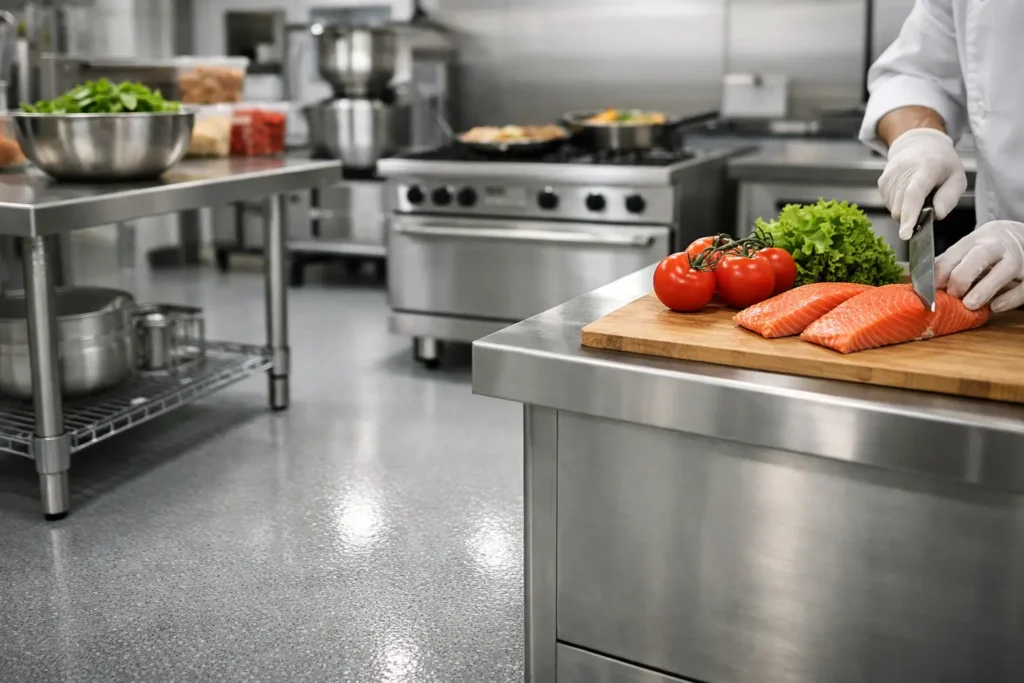
A food preparation area has to work hard long after service ends. Oils, water, dropped utensils, hot equipment, frequent cleaning and constant footfall all leave their mark. Epoxy coatings for food prep areas offer a considered alternative to tiled or heavily jointed surfaces, creating a smooth, practical foundation that can also complement the character of a kitchen, café or professional workspace.
The appeal is not simply that resin looks clean. A correctly specified and professionally installed epoxy system can reduce the joints and vulnerable edges where dirt and moisture tend to collect. It gives a space a more composed finish while supporting the day-to-day disciplines that food environments demand.
Why epoxy coatings suit food prep areas
Grout lines, damaged vinyl seams and cracked concrete can make cleaning more difficult than it needs to be. Each break in a surface creates a potential trap for residue, moisture and bacteria. Epoxy creates a continuous finish across the main field of the floor, and it can be paired with formed coving at wall junctions to remove the awkward right angles that collect debris.
This makes routine cleaning more straightforward, but it also changes how the room feels. A seamless floor has a calm, purposeful quality. In an open-plan commercial kitchen, a bakery production room or a high-spec domestic kitchen, that visual clarity can make the entire space appear more refined.
Epoxy is also valued for its resistance to wear. A suitable system can stand up to regular pedestrian traffic, trolley movement, spills and many of the cleaning products used in food settings. The exact performance depends on the resin build, the topcoat and the preparation beneath it, so a decorative domestic kitchen and a busy catering operation should never be treated as the same specification.
Hygiene begins with the right surface system
A resin floor is not automatically suitable for every food environment simply because it is seamless. The detail matters. Food preparation spaces need a system chosen around their use, cleaning regime, temperature changes and expected traffic.
For instance, a light-use staff kitchenette may benefit from a smooth satin finish that feels at home beside contemporary cabinetry. A commercial prep room may need a more substantial build, chemical-resistant finish and a texture designed to improve grip when the floor is wet. That added texture can be a sensible safety measure, although it requires thoughtful selection: an overly aggressive finish can hold onto dirt and take longer to clean.
The best finish is therefore rarely the roughest or the glossiest. It is the one that balances slip resistance, ease of maintenance and the visual language of the interior. This is where sample-led decisions are valuable. Colour, aggregate, sheen and texture should be considered under the actual lighting of the space, not only from a small image on a screen.
Floors, walls and worktops are different applications
Epoxy coatings can be used across floors and certain wall finishes, but direct food-contact surfaces call for a separate conversation. A floor coating designed for a commercial kitchen is not necessarily approved for direct contact with food, and it should not be assumed to be suitable for chopping, plating or serving surfaces.
Where a resin finish is proposed for a counter, island or worktop, the system must be assessed specifically for that intended use. This includes the relevant food-contact requirements, heat exposure, cleaning chemicals and the likelihood of cuts or abrasion. Clear specification avoids a beautiful surface being asked to do a job it was never designed for.
The installation beneath the finish matters most
Epoxy is unforgiving of shortcuts. Its polished appearance can conceal none of the problems in a poorly prepared substrate, and premature failure is often rooted in the concrete below rather than the coating above.
Before installation, the floor must be assessed for soundness, contamination, movement and moisture. Old adhesives, grease and weak laitance need to be removed, while cracks and damaged areas should be repaired with compatible materials. Mechanical preparation creates the right profile for adhesion; applying resin over a dusty, smooth or compromised base is a false economy.
Moisture deserves particular attention in ground-floor kitchens, older buildings and spaces with uncertain damp protection. Excess moisture vapour can interfere with adhesion or cause blistering. Depending on the readings and the condition of the slab, a moisture-tolerant primer or damp-mitigation layer may be required before the epoxy is laid.
Installation also needs to be planned around access. Resin systems cure in stages, and food operations may need to close or work around phased areas while the surface is prepared and allowed to harden. A realistic programme protects both the installation quality and the business operating from the premises.
Designing a food space that still feels distinctive
Practical does not have to mean anonymous. Food prep areas are often highly visible, particularly in cafés, bakeries, restaurants with open kitchens and homes where cooking is part of everyday entertaining. The floor can support the wider design rather than disappear into it.
Neutral mineral tones can bring softness to stainless steel and white cabinetry. A terrazzo-inspired resin overlay can introduce visual movement without the maintenance demands of numerous tile joints. For a more architectural scheme, concrete-effect resin can deliver a quiet, monolithic backdrop that lets timber, brass, tiles or statement lighting take focus.
Colour selection should still account for use. Very pale finishes reveal every scuff and crumb, while extremely dark colours may show flour, dust and streaks after cleaning. Mid-tones, fine aggregate and a lower-sheen finish are often more forgiving in working environments. A bespoke sample can help establish whether a colour feels inviting while remaining practical at service level.
Maintenance is simple, not careless
One of the strongest reasons to specify epoxy in a food prep setting is that maintenance can be more manageable than with porous or heavily jointed finishes. Regular sweeping followed by cleaning with an appropriate neutral cleaner is usually the starting point. Spills should be dealt with promptly, particularly oils, acidic ingredients and strongly coloured products.
That does not mean every chemical is suitable. Highly abrasive pads, harsh solvents or an unsuitable degreaser can dull or gradually damage a topcoat. The cleaning products, dilution and frequency should match the installed system and the hygiene procedures already in place.
Furniture legs, movable equipment and metal shelving should be fitted with suitable protection where practical. If a coating is damaged, local repairs may be possible, though the appearance of a repair can depend on the colour, texture, age and exposure of the original finish. Preventing concentrated wear is always preferable to trying to disguise it later.
Questions to resolve before specifying epoxy
The most successful projects begin with honest answers about how the area will be used. Is it a domestic kitchen with occasional heavy cooking, or a commercial space cleaned several times a day? Will hot oil, forklifts, wheeled racks, delivery traffic or constant wet working be part of the picture? Does the floor need hygienic coving, drainage falls or a particular slip-resistance level?
It is equally useful to consider the visual brief early. A resin surface can be deliberately understated or become a defining feature. Deciding whether the aim is a soft terrazzo effect, a clean block colour or a concrete-inspired finish helps align technical choices with the architecture from the outset.
For projects across Essex and London, Resinize approaches these questions as part of the design process, bringing material knowledge and craftsmanship together rather than treating performance and appearance as separate decisions.
A food prep floor should make the working day easier, but it should also contribute to a space people want to spend time in. Start with the conditions the surface must withstand, then choose the finish that gives those practical demands a more considered, lasting expression.