
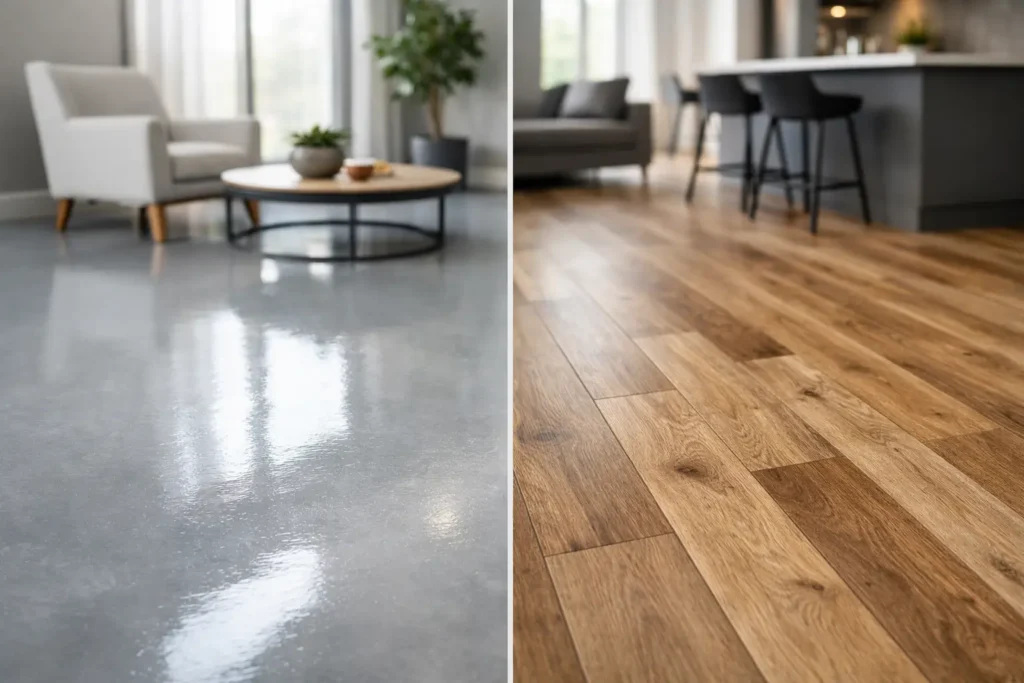
A floor can either quietly support a room or become the detail that gives it identity. When considering resin versus vinyl flooring, the real choice is not simply between two practical surfaces. It is between a bespoke, continuous finish shaped around your space and a manufactured product chosen from a collection. Both have a place, but they create very different interiors.
For a family kitchen, a calm bathroom, a design-led retail unit or a hard-working garage, the right answer depends on how the room is used, the condition of the subfloor and how much creative freedom you want from the finished surface.
Resin versus vinyl flooring: the essential difference
Vinyl flooring is a factory-made material, generally supplied as sheet vinyl, tiles or planks. Luxury vinyl tile, often known as LVT, has become a familiar choice for homes because it can imitate timber, stone and patterned tile while offering a softer feel underfoot than ceramic. It is a practical, recognisable option with a broad range of price points.
Resin flooring is created on site. A specialist installer prepares the substrate and applies a multi-layer system which cures into a continuous surface. Depending on the brief, this can be an understated concrete-effect floor, a terrazzo-inspired overlay, a rich metallic finish or a refined single colour. The absence of grout lines, joins and repeated plank patterns gives resin a distinctly architectural quality.
That difference in process matters. Vinyl starts with a pre-set visual. Resin begins with a design conversation: light levels, existing materials, room proportions, desired texture and the way the surface should feel as you move through the space.
Design freedom and visual impact
For projects where the floor is expected to contribute to the overall scheme, resin has greater scope. Colour can be tailored to complement cabinetry, wall finishes or a brand palette. Decorative aggregates can introduce depth, while metallic pigments can create movement that changes gently with the light. Each hand-finished resin floor has its own character.
This does not mean every resin surface has to be dramatic. A soft stone tone or matt concrete-effect finish can make a compact kitchen, hallway or garden room feel more expansive by allowing the floor to run uninterrupted from one area to the next. Resin can also continue up a wall or form a coved detail in suitable settings, creating a composed, seamless result.
Vinyl is more limited, though not without appeal. Its strength lies in choice and predictability. If the aim is a particular oak board, herringbone layout or encaustic-style tile print, LVT offers an efficient route to that look. In a room with many visual elements already competing for attention, its familiar patterning may be exactly what the scheme needs.
The trade-off is repetition. Even high-quality vinyl follows a printed design and uses a finite number of visual repeats. Resin does not imitate another material unless that is the intention. It is a surface finish in its own right.
Everyday durability is about the setting
Both materials can perform well, but they should be specified for the job rather than judged by a single claim of durability. Quality vinyl is resilient, water-resistant and forgiving in busy homes. It works particularly well in bedrooms, lounges and lower-impact domestic spaces where comfort and quick installation are priorities.
A correctly specified resin system can be exceptionally durable. It is well suited to kitchens, hallways, bathrooms, utility rooms, garages, retail spaces and commercial environments where a polished appearance must stand up to regular use. Heavy-duty resin coatings can be designed for vehicle traffic, equipment, spillages and demanding cleaning routines.
Resin is not indestructible, and that is worth saying clearly. A dropped cast-iron pan, dragged metal furniture or severe impact can mark any decorative floor. The advantage is that a professional system can be selected with the right balance of hardness, flexibility and finish for its location. A garage needs different performance from a boutique shop, just as a sunlit conservatory needs different consideration from an internal corridor.
Vinyl can dent or tear under concentrated pressure and sharp edges. Individual LVT planks or tiles may sometimes be replaced, which is useful, but matching an older batch can be difficult once a range has changed or the floor has faded naturally over time.
Water, slip resistance and wet rooms
Resin and vinyl are both popular in areas where water is part of daily life, but installation details make the difference. Vinyl needs carefully sealed seams and perimeter edges to protect the subfloor. Sheet vinyl has fewer joins than LVT, while planks and tiles introduce more potential edge lines.
A seamless resin finish removes those surface joins. In bathrooms, kitchens and commercial back-of-house areas, that can make cleaning simpler and create a more refined appearance. The system must still be designed properly around drains, thresholds and wall junctions. A wet-room floor also needs appropriate falls and a finish with suitable slip resistance, rather than simply the glossiest possible coating.
Comfort, sound and the feel underfoot
Vinyl generally feels warmer and more cushioned than resin. Its flexible composition absorbs some impact and softens footfall, which can be welcome in a bedroom or a flat where reducing transmitted sound is a concern.
Resin has a firmer feel, comparable to other continuous mineral-style finishes. Underfloor heating changes the experience considerably and is a popular pairing in contemporary homes. When installed over a suitable heated screed and brought up to temperature gradually, resin can provide a clean, comfortable floor without radiators interrupting the visual flow of the room.
Acoustics depend on the complete floor build-up, not just the top finish. If sound reduction is central to the project, it should be addressed early with the right underlay or acoustic system. It is far more effective to plan for this before a finish has been chosen than to try to solve it afterwards.
Installation: speed versus preparation
Vinyl is often quicker to lay, especially where the subfloor is already smooth, dry and sound. This can be valuable on projects with a tight programme or in rooms that need to return to use promptly. However, it is not a shortcut around poor preparation. Unevenness, moisture and movement beneath vinyl can telegraph through or compromise adhesion.
Resin installation is more process-led. The substrate is assessed, repaired and prepared before the chosen layers are applied. Moisture levels, existing coatings, cracks and floor levels all influence the specification. Curing time also needs to be allowed for, particularly where several coats, decorative elements or a protective topcoat are involved.
That preparation is not an inconvenience for its own sake. It is where long-term finish quality is won. A seamless floor will reveal careless groundwork, while a meticulously prepared base allows the final surface to look intentional, level and beautifully resolved.
For homeowners in Essex and London renovating older properties, this is especially relevant. Original slabs and screeds often need more attention than newly built rooms, but they can still become the foundation for a striking resin finish when assessed properly.
Cleaning and long-term care
Vinyl is easy to live with. Regular vacuuming or sweeping followed by a damp mop and a suitable neutral cleaner is usually enough. Avoid harsh abrasives and excessive water at seams. Protective pads beneath furniture help prevent scuffs and dents.
Resin is equally straightforward to maintain because dirt has nowhere to settle between boards or grout lines. Most spaces need only routine sweeping and mopping with a pH-neutral cleaner. In commercial environments, the right cleaning regime also protects the topcoat and preserves the intended sheen.
The finish selected has a role here. High gloss can look striking but naturally shows smudges and fine marks more readily than satin or matt. For many homes and busy commercial spaces, a softer sheen is the more forgiving and timeless choice.
Cost: compare the full value, not only the quote
Vinyl usually has a lower entry cost, especially in standard ranges and straightforward rooms. It can be an intelligent choice where budgets are tight, a property is being refreshed for rental, or a familiar timber or tile effect is the design goal.
Resin is a premium, bespoke installation, so the initial investment is commonly higher. The price reflects substrate preparation, specialist materials, design development and skilled application. Complex decorative finishes, larger repairs and unusual details will affect the cost further.
However, cost should be measured against the role the floor plays in the finished property. A continuous resin surface can remove the need for multiple transitions between kitchen, dining and hallway areas, while giving the interior a distinctive signature. In a customer-facing commercial setting, it can also turn a functional surface into part of the brand experience.
Which floor belongs in your project?
Choose vinyl when you want a comfortable, efficient and familiar finish, particularly for lower-impact rooms or schemes built around a convincing timber, stone or tile appearance. Choose resin when the surface itself is part of the design ambition, when seamless hygiene and easy maintenance matter, or when the space needs a more tailored level of resilience.
The most successful projects do not force one material into every room. A calm resin floor may set the tone through an open-plan ground floor, while vinyl brings softness to upstairs bedrooms. The key is to select each surface with the room, the people using it and the desired atmosphere in mind.
A sample viewed in your own light is often the moment the decision becomes clear. It shows not only colour and texture, but the kind of space you are about to create.