
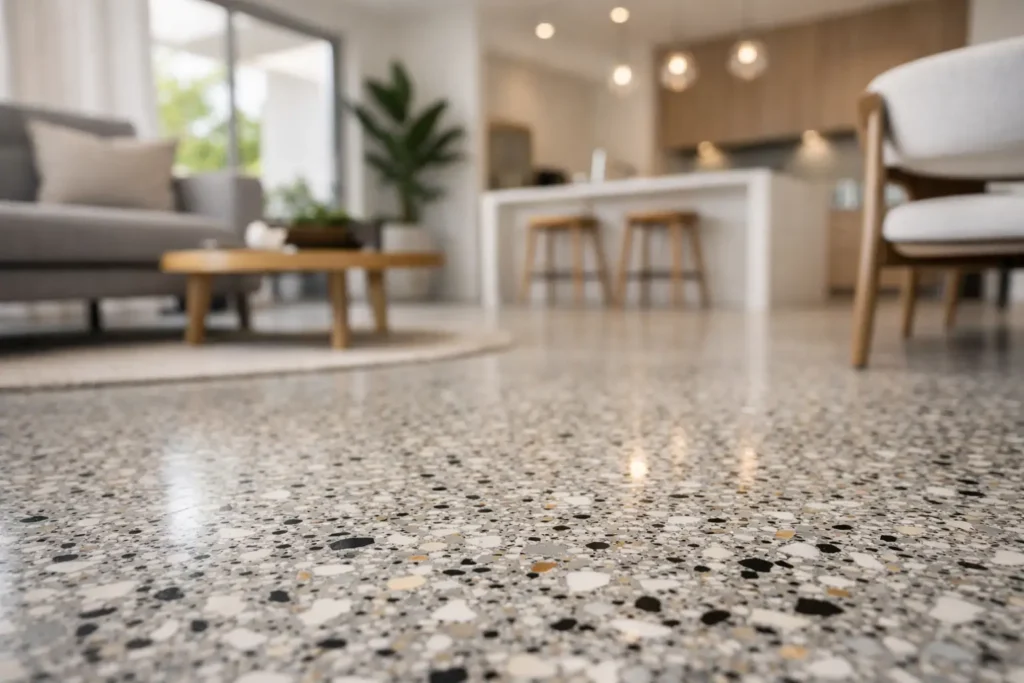
A floor can make a beautifully planned room feel complete, or make every other finish work harder than it should. In this terrazzo overlay flooring review, we look beyond the visual appeal of coloured chips and polished depth to assess how this distinctive resin finish performs in real homes and commercial interiors.
Terrazzo-inspired overlays are increasingly specified for kitchens, hallways, bathrooms, retail spaces and feature rooms because they offer a decorative surface without the joints, grout lines and repeated pattern of tiles. They can feel architectural, playful, refined or boldly expressive, depending on the palette and aggregate selected. But they are not a universal answer to every floor. The quality of the existing substrate, the intended use of the space and the standard of installation all matter.
What is terrazzo overlay flooring?
A terrazzo overlay is a decorative resin floor system applied over a prepared existing substrate, usually concrete or a suitable screed. It recreates the character of traditional terrazzo through a resin base combined with decorative aggregate or coloured chips, before being sealed to create a smooth, continuous finish.
It is worth drawing a distinction here. Traditional terrazzo is typically a cementitious material containing marble, stone or glass aggregate that is ground and polished on site. A terrazzo-inspired resin overlay captures the visual language of terrazzo in a thinner, more adaptable system. That makes it particularly appealing for renovation projects where increasing floor height significantly may be impractical.
The design potential is a major part of the attraction. A soft ivory ground with warm stone flecks can bring quiet texture to a contemporary kitchen. Deep green, terracotta or charcoal tones can create a more dramatic statement in an entrance hall or hospitality setting. Because the composition is selected for the project, the result feels considered rather than off the shelf.
Terrazzo overlay flooring review: the advantages
The first advantage is visual continuity. Without tile joints interrupting the surface, a terrazzo resin floor can make compact spaces feel calmer and more expansive. This is especially effective where a kitchen flows into a dining area, or where a hallway needs to connect several rooms with one confident material choice.
It is also highly customisable. The base colour, chip size, chip density and overall balance can be tailored to sit alongside cabinetry, paintwork, metal finishes and natural materials. This gives designers and homeowners far more freedom than a fixed tile range. A sample-led process is valuable here, as resin colours can read differently in daylight, under warm lighting and beside surrounding finishes.
From a practical perspective, the lack of grout lines makes routine cleaning straightforward. Dust and spills have fewer places to settle, which is useful in busy family kitchens, utility areas and commercial settings where presentation matters. A well-specified sealed surface is also resistant to everyday marks and moisture, provided it is cared for appropriately.
Another benefit is the ability to refresh an existing floor rather than remove it entirely. Where a substrate is structurally sound, an overlay can reduce the disruption associated with lifting and replacing a full floor build-up. That does not mean preparation can be skipped, however. The existing floor becomes the foundation for the finished design, so its condition is central to the outcome.
Where the trade-offs begin
The polished, seamless appearance can create an expectation of effortless perfection. In reality, a resin terrazzo floor is a crafted finish, and its performance depends on the work beneath the visible surface. Cracks, movement, dampness or contamination in the substrate need professional assessment before any decorative layer is installed.
Hairline cracks in an existing slab may be repairable, but movement joints cannot simply be ignored. If a floor is actively moving, that movement can transfer through the new finish. Similarly, moisture within concrete can interfere with adhesion or cause later problems if it is not tested and managed correctly. This is one reason a site survey is more valuable than choosing solely from photographs.
The surface may also show fine scratches over time in high-traffic areas, particularly where grit is regularly brought in from outdoors. This is not unique to resin, but the visibility of wear depends on the chosen colour, sheen and use of the room. A mid-toned, lightly textured design is generally more forgiving than a very dark, high-gloss floor in a busy family entrance.
For spaces where slip resistance is a priority, such as bathrooms, commercial entrances or areas exposed to wet footwear, the finish should be specified accordingly. A highly polished aesthetic is not always the right practical choice. There are ways to build in more grip while retaining a refined appearance, but this should be agreed at the design stage rather than treated as an afterthought.
How durable is a terrazzo resin overlay?
When correctly installed and matched to its environment, terrazzo-inspired resin flooring is a durable option for everyday interiors. It is well suited to domestic living spaces, kitchens, halls, bathrooms and carefully specified retail or hospitality areas. Its continuous surface avoids the chipped grout and loose tile issues that can develop over time with conventional tiled floors.
Durability is not simply about hardness. It is about choosing the right resin system, preparing the substrate precisely and applying the correct protective seal. A decorative floor in a quiet sitting room has different demands from a warehouse aisle, a garage or a busy shop entrance. Heavy-duty commercial environments may require a more industrial coating system or a bespoke specification built around chemical exposure, impact and vehicle traffic.
Furniture should still be moved with care, and felt pads under chair and table legs are sensible. In a home with large dogs, children, pushchairs or frequent entertaining, a resilient specification and a realistic conversation about finish are preferable to chasing a showroom-perfect gloss. The best floor is one that continues to look good while being lived on.
Installation: why craftsmanship is visible
A terrazzo overlay is not a quick cosmetic coating. The installation process typically begins with inspection, moisture testing and mechanical preparation of the substrate. The floor must be clean, stable and profiled correctly so the resin bonds as intended. Repairs, levelling work and edge details are completed before the decorative layers are applied.
The resin and aggregate are then installed with careful control over distribution, thickness and colour balance. Once cured, the finish may be refined and sealed according to the chosen system. Each stage affects the final appearance, from the crispness of transitions to the way light moves across the floor.
This is why small sample boards are useful but not the whole story. A sample shows colour direction and texture, while a full floor introduces scale, natural variation, perimeter details and changing light. Experienced installers plan these elements before work begins, particularly in open-plan rooms where a continuous surface has nowhere to hide poor preparation.
At Resinize, this design-led approach is treated as part of the installation rather than an optional extra. The aim is not merely to cover a floor, but to craft a finish that belongs to the architecture of the room.
Maintenance and long-term appearance
Day-to-day care is refreshingly simple. Sweep or vacuum away abrasive dust, then clean using a pH-neutral product recommended for resin floors. Avoid harsh bleach-based cleaners, aggressive solvents and abrasive pads, as these can dull or damage the protective surface over time.
Wipe spills promptly, especially oils, strongly coloured foods and chemicals. Entrance mats are worthwhile in homes and commercial premises, provided they do not trap moisture beneath them. For higher-traffic settings, periodic professional maintenance or resealing may help retain the desired finish and extend the life of the floor.
A terrazzo overlay should not be judged by whether it remains completely unchanged forever. Like timber, stone and other premium materials, it develops a relationship with use. Good specification and sensible care ensure that relationship remains attractive rather than tired.
Is terrazzo overlay flooring worth it?
For a project that calls for a seamless, expressive and durable finish, terrazzo overlay flooring can be a compelling investment. It is particularly worthwhile when standard tiles feel too repetitive, when a space needs visual unity, or when the floor is intended to play an active role in the interior scheme.
It may be less suitable where the existing floor has unresolved structural movement or moisture issues, where the budget cannot accommodate proper preparation, or where a very rough industrial environment calls for a different technical system. The honest answer is that it depends on the building as much as the design brief.
The most successful terrazzo floors begin with a close look at the surface already in place, followed by a palette that feels right for the light, scale and character of the room. When those decisions are made with care, the floor becomes more than a backdrop. It becomes the finish that gives the entire space its point of view.