
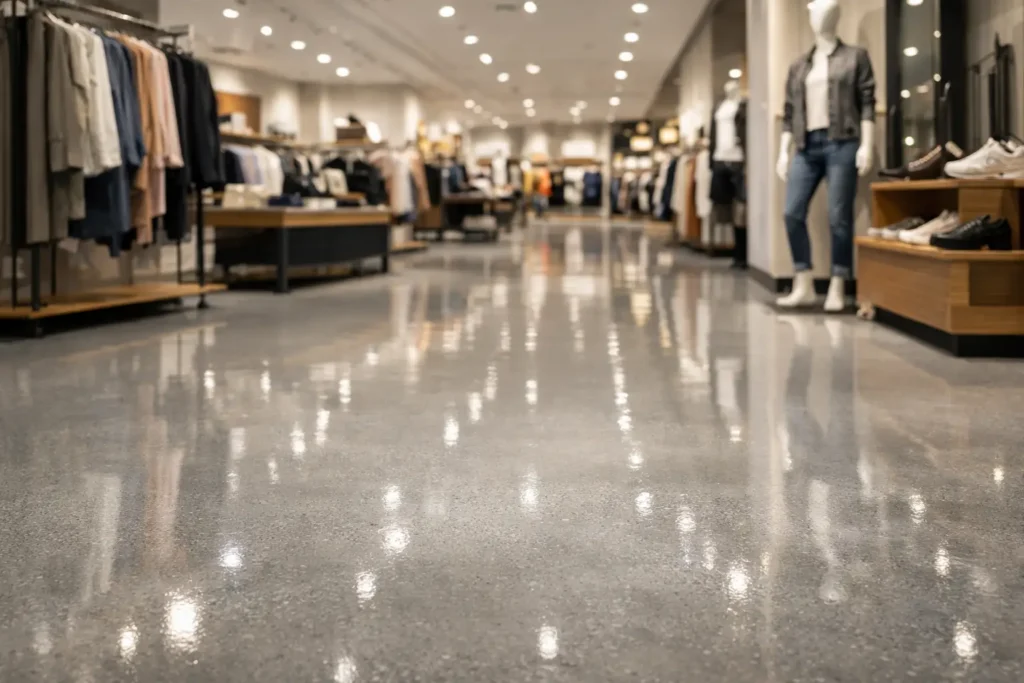
A shop floor has very little time to make an impression. Before a customer has touched a product, spoken to a team member or reached the till, they have already taken in the lighting, layout and finish beneath their feet. This retail epoxy flooring case study examines how a carefully specified resin surface can become part of the customer experience, rather than an afterthought hidden beneath fixtures and displays.
The scenario is illustrative, based on the decisions that regularly shape design-led retail projects. It shows why the best result is not simply the hardest floor available. It is the finish that supports the brand, the building and the pace of the space.
The brief: a floor worthy of the product
Consider an independent lifestyle retailer taking over a compact London unit. The space has good frontage, generous natural light and an edited collection of homeware, fragrance and accessories. Its existing floor is a patchwork of tired vinyl, adhesive marks and uneven repairs – functional enough for opening day, but completely at odds with the refined, tactile identity the owners want to create.
The brief is clear. The new surface needs to feel contemporary and distinctive, withstand daily footfall, tolerate rolling display stands and make routine cleaning straightforward. It must also work as a calm backdrop for changing seasonal displays, rather than competing with every product on the shelf.
A conventional tiled floor could meet some practical requirements, but grout lines would interrupt the visual field and introduce another cleaning consideration. Timber would bring warmth, yet might show scuffs quickly near the entrance and require more care around spills. A decorative epoxy system offers a different route: a continuous, tailored surface with the freedom to shape colour, movement and level of sheen.
Retail epoxy flooring case study: choosing the right look
The retailer initially gravitates towards a high-gloss pale finish. It looks striking on a small sample and promises to bounce light around the room. In a busy shop, however, gloss can exaggerate footprints, dust and surface marks. Pale colours can also be less forgiving close to a street-facing entrance, especially in wet British weather.
The chosen direction is a soft stone-grey decorative epoxy floor with subtle mineral variation and a satin finish. It gives the interior a gallery-like clarity without becoming cold or clinical. The gentle tonal movement adds depth across the larger floor area, while remaining quiet enough to let the merchandise lead.
This is where sample-led decision-making earns its place. A resin sample should be viewed upright and flat, in daylight and under the actual lighting planned for the shop. It should sit beside joinery, paint colours, metalwork and key products. A finish that feels perfectly balanced in a showroom can read differently beneath warm pendant lights or against a bold shopfront palette.
The right level of movement also matters. A heavily marbled metallic finish may be exactly right for a statement beauty counter or a concept store built around drama. For a retailer with an evolving product range, restrained artistry provides more flexibility. There is no universal ‘best’ epoxy look – the design has to serve the commercial setting.
Preparing the canvas beneath the surface
The most visible part of a resin floor is the final finish, but much of its performance depends on work the customer will never see. Once the old coverings are removed, the substrate must be assessed for soundness, moisture, contamination and level.
In this case, several old adhesive residues are discovered alongside localised cracks and low spots. Applying a decorative coating straight over them would risk telegraphing imperfections through the finished floor or compromising adhesion. The installation plan therefore includes mechanical preparation, crack repairs and a levelling stage before the decorative layers begin.
This part of the project can affect programme and budget, which is why an honest site survey is more valuable than a quick estimate based on square metres alone. Retail premises often carry the history of previous tenants: old screeds, patched channels, coatings, damp-related issues or unexpected differences in floor height. Good craftsmanship means responding to what is actually there, not forcing a standard specification onto every unit.
For a shop due to open on a fixed date, programme planning is equally important. Resin systems cure in stages, and the floor needs adequate time before it takes the weight of fittings, stock and daily traffic. The project should be coordinated around joinery, decorating, electrical work and merchandising so the completed surface is not put at risk by late trades.
Crafting performance into the design
The finished floor is not treated as a decorative layer alone. At the entrance, where rainwater and grit are most likely to arrive, the retailer uses high-quality entrance matting to protect the surface and reduce slip risk. This small detail helps preserve appearance and keeps cleaning manageable.
A suitable topcoat is selected to support the required satin finish and day-to-day durability. The exact specification depends on use. A boutique with modest footfall has different demands from a convenience retailer, salon or showroom where heavy units are moved frequently. If the site is likely to see wheeled stock cages, concentrated point loads or persistent chemical exposure, the system needs to be designed accordingly.
Slip resistance also deserves a considered conversation. More texture can improve grip, particularly in areas exposed to moisture, but it can change the feel underfoot and make cleaning more involved. A refined retail environment may not need the same profile as a commercial kitchen or service bay. The aim is a sensible balance between safety, appearance and maintenance – never a one-size-fits-all solution.
The result is a continuous floor plane that makes the modest footprint feel broader and more intentional. Without busy joints breaking up the room, display plinths and freestanding rails appear more considered. The floor catches light softly, adding polish without turning the interior into a mirror.
What changed after opening
The clearest improvement is not only visual. The new finish gives the retailer a consistent foundation for product photography, launches and window-to-floor sightlines. It becomes part of the brand atmosphere: calm, crafted and quietly distinctive.
Operationally, the team no longer has grout to scrub or loose edges of sheet flooring to monitor. A regular routine of sweeping to remove abrasive grit and mopping with a suitable cleaner keeps the surface looking its best. Prompt attention to spills remains good practice, as does using protective pads beneath heavy movable displays.
There are trade-offs. Decorative epoxy is a specialist finish, not a low-cost shortcut. The quality of preparation, the skill of the installation team and the chosen design all influence price. It is also not a material that should be selected solely from an online photograph. Colour variation, lighting, texture and sheen need to be understood in the setting where they will live.
Yet for this type of project, those decisions deliver value beyond a simple floor replacement. The retailer gains a surface that can take part in the visual story of the space while standing up to its working life.
Questions to ask before specifying epoxy for retail
Before committing to a finish, a retailer should be able to answer a few practical questions. How will customers move through the space? Where do wet shoes, deliveries and cleaning equipment enter? Will fixtures stay in place for years, or be rearranged every month? Is the floor intended to blend quietly into the scheme, or make a statement of its own?
It is also worth considering the future. A neutral, well-crafted resin floor can support a change in branding, new paint colours or a different merchandising approach without requiring a full refit. For landlords and operators, that adaptability can be just as valuable as immediate impact.
For retail spaces across Essex and London, Resinize approaches these conversations as both a design exercise and a technical one. The strongest schemes begin with the realities of the site, then use colour, texture and finish to craft a surface with genuine presence.
A memorable shop should not ask its floor to disappear. It should ask it to carry the atmosphere of the brand, withstand the rhythm of the day and still look considered when the last customer has left.