
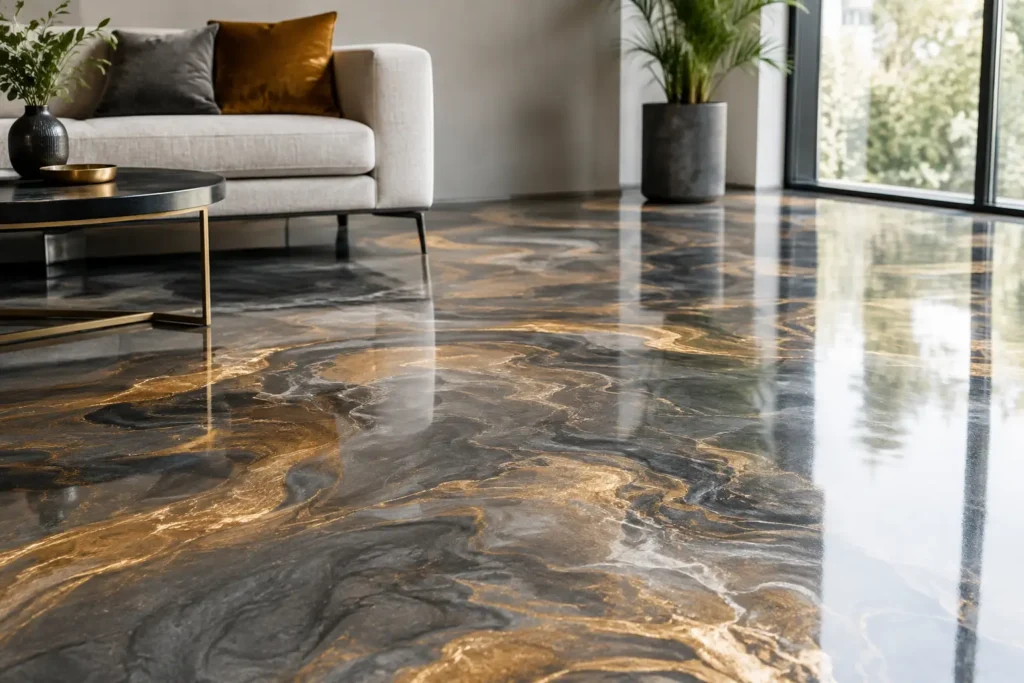
A metallic resin floor is never simply a colour choice. It is a moving composition of pigment, light and texture that changes as you cross the room. This metallic epoxy guide is for homeowners and commercial decision-makers who want that visual impact without losing sight of what makes a surface practical, durable and beautifully finished.
Unlike tiles, timber boards or patterned vinyl, metallic epoxy is poured as a continuous system. There are no grout lines to interrupt the design and no repeated pattern to make the floor feel manufactured. The result can be quietly luxurious, dramatically expressive or somewhere in between, depending on the palette, pigments and application technique chosen.
What is metallic epoxy?
Metallic epoxy is a decorative resin coating created by blending specialist metallic pigments into a clear or tinted epoxy base. As the material is poured and worked across the surface, those pigments move through the resin to create depth, veining, clouds, ripples or mineral-like movement.
The finish is not printed on top of the floor. It is formed within the resin itself. That is why two installations using the same colours can still look entirely different. A charcoal and silver scheme may resemble polished stone in one room, then become a more dramatic, smoke-like composition in another.
Once the decorative layer has cured, it is normally protected with a hard-wearing clear topcoat. This helps define the sheen, improves resistance to everyday wear and makes cleaning straightforward. A high-gloss finish heightens reflection and depth; satin can offer a softer, more architectural look. Neither is automatically better. The right choice depends on the room, the available daylight and the atmosphere you want to create.
Where does a metallic epoxy floor work best?
Metallic epoxy earns its place where a surface is expected to do more than disappear into the background. It works particularly well in entrance halls, open-plan kitchens, dining areas, garden rooms, home bars, bathrooms and feature retail spaces. In a commercial setting, it can give a showroom, salon, studio or reception area a finish that feels closely tied to the brand rather than purely functional.
A garage can also be an excellent candidate, especially when the goal is to turn a utilitarian space into a considered part of the home. However, the design should respond to the setting. A busy, highly reflective pattern may be right for a statement room but less suitable for a large work area where a calmer, more forgiving finish is preferred.
Metallic resin is not reserved for floors. Used on selected walls, counters or vertical features, it can bring the same sense of depth to a space without covering every surface. Restraint often produces the strongest result. A feature wall beside a seamless floor, for example, can feel more intentional than matching everything from floor to ceiling.
The design decisions that shape the final look
The phrase “metallic epoxy” covers a wide range of finishes. Before colours are selected, it helps to decide what role the surface should play in the interior. Should it anchor a minimal scheme with a restrained stone-like effect, or should it become the focal point of the room?
Colour is only the starting point
Pigments behave differently under warm and cool lighting. Bronze, copper and gold can bring richness to timber, dark cabinetry and soft neutral walls. Silver, pearl, graphite and deep blue often feel sharper and more contemporary. Black can add drama, but it also makes dust, pale debris and reflected light more noticeable, particularly in a glossy finish.
Samples are valuable because they show how colours sit together, but a small sample cannot replicate the scale of a full room. Pigment movement expands across larger areas, and natural light will alter the perceived depth throughout the day. A professional consultation should consider surrounding materials, lighting temperatures, furniture and the level of visual activity that feels right for the space.
Movement needs proportion
Metallic effects can be soft and layered or bold and high-contrast. Fine veining and subtle tonal shifts suit interiors where other elements, such as joinery or artwork, already carry visual weight. Stronger cells, swirls and colour transitions can work beautifully in a simple room with clean lines.
There is a trade-off here. The more elaborate the pattern, the more the floor becomes a defining feature. That is often exactly the point, but it should be chosen with confidence rather than treated as an afterthought.
Sheen changes the room
Gloss is associated with classic metallic epoxy because it amplifies the sense of liquid depth. It can make a smaller space feel brighter, especially where light is allowed to travel across the surface. Yet gloss also reveals reflections, footprints and surface dust more readily.
A satin topcoat is often a thoughtful option for family homes, busy entrances and spaces with strong daylight. It retains the richness of the pigment while creating a calmer, less reflective appearance. For areas where water may be present, such as bathrooms or entranceways, slip-resistance can also be incorporated without compromising the overall design intent.
Substrate preparation is where quality begins
The most striking resin design cannot compensate for a poorly prepared base. Metallic epoxy is only as reliable as the substrate beneath it, which is why the preparation stage deserves as much care as the decorative pour.
Concrete must be assessed for soundness, contamination, moisture and existing coatings. Cracks may need repairing, uneven areas may need levelling, and old adhesives, paint or laitance must be mechanically removed where necessary. The goal is a clean, stable profile that allows the resin system to bond correctly.
Moisture is especially relevant in ground-floor spaces and older properties. If excessive moisture vapour is present, an appropriate moisture barrier may be required before the decorative layers are installed. Skipping this stage can lead to adhesion problems or visible defects later, which is why a site assessment should guide the specification rather than a one-size-fits-all promise.
Preparation can also influence the visual result. A self-levelling base may be used to create the smooth, even canvas needed for a refined metallic finish. This adds time and cost, but it protects the quality of the completed surface.
What installation involves
A bespoke metallic resin floor is a sequence of carefully timed stages rather than a single pour. Once the substrate is prepared and primed, base layers and decorative metallic resin are applied in a controlled process. The installer manipulates the pigments while the material is workable, balancing planned colour direction with the natural movement that makes the finish unique.
After curing, the floor receives its protective topcoat and is left to reach the required level of hardness before being brought into normal use. The exact programme depends on the condition of the base, the chosen system, ambient temperature and whether additional repairs or levelling are needed.
This is not a finish that benefits from rushing. Temperature, humidity, mixing ratios and application windows all affect resin. Experienced installation is what turns a striking sample into a surface that looks considered from every angle and performs under daily use.
Maintenance without the fuss
A seamless metallic epoxy floor is refreshingly simple to care for. Regular dry cleaning removes grit that can act like an abrasive, while a soft mop and a pH-neutral cleaner deal with everyday marks. Avoid harsh solvents, strongly alkaline products and abrasive pads, as these can dull or damage the protective topcoat.
Felt pads beneath furniture, mats at external doors and prompt attention to spills will help preserve the finish. In hard-working commercial settings, maintenance plans should reflect footfall, wheeled traffic and the specific cleaning regime already used on site.
Like any premium surface, resin can pick up fine marks over time, particularly in high-traffic zones. The advantage of a professionally specified system is that protective coatings can often be assessed and renewed when appropriate, extending the life and appearance of the floor without replacing the whole surface.
Is metallic epoxy the right choice for your project?
Metallic epoxy is ideal for clients who value individuality. It offers a seamless, durable and highly personalised surface, but it is not designed to imitate tile or wood perfectly. Its appeal lies in its artistic variation, reflective depth and ability to make an interior feel genuinely bespoke.
For a quieter aesthetic, a terrazzo-inspired overlay, concrete-effect resin or a more understated decorative coating may suit the brief better. For an environment with heavy machinery, pallet movement or aggressive chemical exposure, a heavy-duty commercial resin system may need to take priority over a decorative metallic finish.
The best projects begin with an honest conversation about how the room will be used, what the existing substrate can support and how much visual presence the surface should have. For homes and businesses across Essex and London, Resinize approaches that conversation as both a design exercise and a technical specification. A well-chosen metallic resin floor should still feel purposeful long after the first impression has passed.