
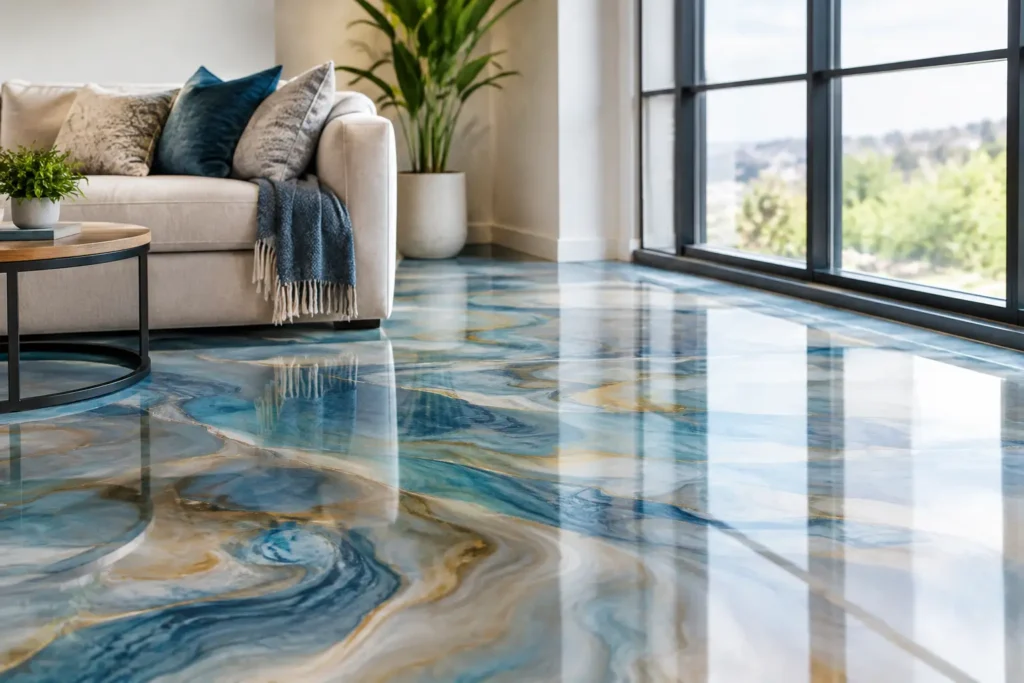
A floor occupies more visual space than almost any other finish in a room, yet it is often treated as a background decision. Custom resin floor patterns change that. They allow the surface beneath your feet to carry colour, movement, texture and personality, while retaining the practical strength needed for everyday living or demanding commercial use.
The most successful resin floors do not simply imitate another material. They are designed around the architecture of the space, the available light and the feeling a client wants to create. A soft terrazzo-inspired scatter can bring warmth to a kitchen extension; a flowing metallic composition can give a reception area a sense of theatre; a restrained concrete-effect finish can ground a contemporary bathroom without making it feel cold.
Why custom resin floor patterns deserve a design conversation
Pattern in resin is not limited to a repeated motif. It can be expressed through aggregate placement, tonal shifts, veining, layered pigments, directional movement or a carefully balanced blend of flakes. This is what makes resin such an expressive architectural finish: the design can be quiet and considered, or it can become the focal point of the room.
Unlike standard tiles, planks or sheet flooring, resin can be laid as a continuous surface across open-plan areas. That gives designers and homeowners more freedom to create visual flow between a kitchen, dining space and hallway. In commercial interiors, the same approach can reinforce a brand identity without sacrificing the hard-wearing qualities a busy site requires.
The key is restraint. A highly decorative floor may look compelling in a sample, but a large expanse needs the right scale and balance. Pattern should complement cabinetry, wall finishes, lighting and furniture rather than compete with every one of them. Bespoke design is not about adding more. It is about making the right choices with precision.
The custom resin floor patterns that shape a room
Terrazzo-inspired compositions
Terrazzo-inspired resin overlays remain a favourite for interiors that need character without visual noise. Coloured chips or aggregates are scattered through the resin and finished to reveal a varied, tactile-looking surface. The result can feel playful, refined or distinctly architectural depending on the palette and chip size.
For a calm residential scheme, consider a warm off-white base with sand, clay and soft grey fragments. For a retail or hospitality setting, a bolder base colour with contrasting flecks can become part of the customer experience. The beauty of a bespoke composition is that the balance can be adjusted before installation, rather than selecting from a fixed range on a showroom rack.
Metallic movement and poured artistry
Metallic resin patterns bring depth that shifts with changing light. Pigments can be worked into sweeping currents, cloud-like formations or mineral-inspired layers, creating a surface with real presence. These finishes are especially effective in feature spaces, bars, showrooms, salons and statement entrance halls.
There is a trade-off to consider. Metallic effects are intentionally expressive, so they suit rooms where the floor has permission to be noticed. In a compact space already filled with patterned tiles, busy worktops or strong wallpaper, a more restrained finish may give the room greater longevity. The best result comes from viewing the entire interior as one composition.
Concrete-effect finishes with tonal depth
Concrete-effect resin delivers a contemporary, pared-back appearance without the visual interruption of conventional flooring joints. It is often chosen for kitchens, bathrooms, studios and modern commercial spaces where a calm, gallery-like backdrop is wanted.
The word “concrete” can suggest a flat grey slab, but the most refined resin interpretations have subtle tonal variation. Charcoal, mushroom, stone, taupe and pale mineral shades can each be developed with a gentle mottling that avoids a lifeless finish. This is pattern at its most understated: enough movement to give the surface character, without asking for attention.
Flake systems with a tailored edge
Decorative flake finishes are a practical choice for garages, utility areas, workshops and commercial back-of-house spaces, but they need not look purely industrial. A well-chosen flake blend can introduce warmth, disguise day-to-day marks and create a polished finish that feels considered from the first step inside.
The pattern is created through the distribution and density of the flakes. A full broadcast creates an even, richly textured visual, while a lighter scatter can retain more of the base colour. For high-traffic environments, this balance between appearance and practicality matters. A floor should work hard, but it should also look like it belongs to the building.
Designing for light, scale and use
Before choosing colours or effects, look at how the room behaves. Natural light can reveal the depth of metallic pigments and terrazzo-style blends beautifully, while darker rooms may benefit from a lighter base to avoid a heavy feel. Artificial lighting matters too. Warm lighting tends to soften earthy colours; cooler lighting can sharpen greys, whites and blue-toned finishes.
Scale is equally influential. A fine chip blend or delicate mottling usually reads well in smaller bathrooms and hallways. Larger aggregate, pronounced veining or dramatic metallic movement often has more impact across an open-plan ground floor, retail unit or reception area. The pattern needs enough room to breathe.
Then there is use. A family kitchen needs a surface that can handle dropped pans, muddy shoes and regular cleaning. A warehouse or garage needs a coating system selected for loading, vehicle movement and the condition of the existing substrate. A beautiful floor is only a successful floor when its specification suits the life happening on top of it.
Samples turn an idea into a confident decision
Photographs are useful for inspiration, but they cannot fully show how resin responds to light, how a metallic pigment catches the eye or how a terrazzo blend sits beside a chosen cabinet door. Sample-led decisions make a meaningful difference, particularly where colour and pattern are central to the brief.
A considered sample process allows the finish to be refined before work begins. A base shade can be warmed or cooled. A flake blend can be made quieter. Metallic movement can be guided towards a more organic or more structured look. This is where craftsmanship meets collaboration: the aim is not simply to reproduce a trend, but to create a surface with a natural place in the finished interior.
It is also worth discussing practical details at this stage. Existing floor condition, moisture, preparation requirements, room transitions and curing time all influence the installation plan. Resin rewards careful groundwork. The visual finish may be artistic, but the performance depends on methodical preparation and a system suited to the site.
A pattern should still feel right years from now
Trend-led interiors can be exciting, but the strongest custom resin floor patterns have staying power because they connect to the building and the people using it. A muted stone-toned floor may support changing furniture and décor for years. A bolder feature finish can remain distinctive when it is intentionally contained within the right setting, such as a bar area, cloakroom or branded commercial zone.
Maintenance also plays a part in long-term appeal. Resin surfaces are designed to be straightforward to care for, with regular sweeping and appropriate cleaning helping retain their finish. In demanding environments, selecting the right protective topcoat can make a practical difference to scratch resistance, slip performance and ease of upkeep.
Custom resin flooring offers an opportunity to stop treating the floor as an afterthought. Start with the mood of the space, test the colours in its real light and let the pattern serve both the architecture and the life lived within it. That is how a practical surface becomes a lasting part of the design.