
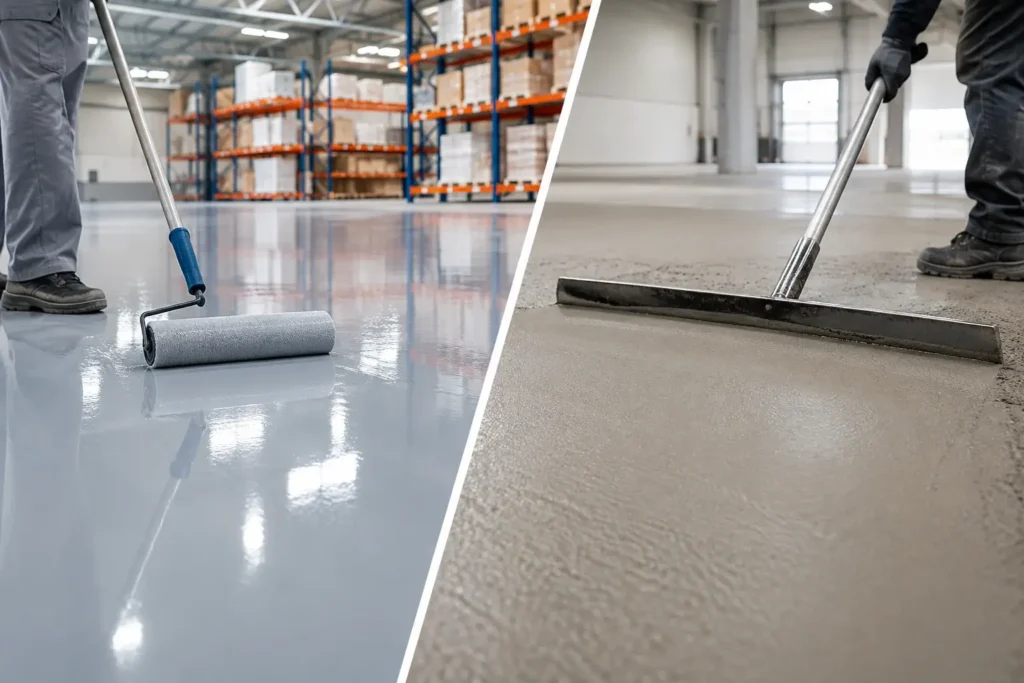
A warehouse floor is rarely judged on day one. The real test arrives with pallet lorries, forklift turns, dropped loads, tyre marks, cleaning regimes and the constant movement that keeps a business trading. In the warehouse epoxy coating vs screed decision, the right answer depends less on a single product claim and more on what the existing slab needs, how the space operates and the finish you want visitors and staff to see.
Both systems can create a hard-wearing commercial surface, but they do very different jobs. Screed is usually the foundation for a better floor. Epoxy coating is a protective, design-led wearing surface. Treating them as interchangeable can lead to poor performance, unnecessary expense or a floor that looks tired before it should.
Warehouse Epoxy Coating vs Screed: The Core Difference
A screed is a layer of cement-based material laid over a structural concrete slab. Its purpose is to level, smooth, raise or reshape the floor. It can correct uneven areas, cover services, form falls towards drainage and provide a more suitable base for a final finish. In warehouse settings, a heavy-duty or industrial screed may be chosen where the existing slab has significant imperfections or where levels need altering.
An epoxy coating is a resin-based finish applied over a prepared concrete or screed substrate. It creates a sealed, seamless surface that is easier to clean and can be specified in a wide range of colours, textures and slip-resistant profiles. Epoxy does not replace serious structural repairs or solve major level issues on its own. It needs a sound, dry and correctly prepared base to perform at its best.
Put simply, screed deals with the shape and condition of the floor. Epoxy deals with its protection, appearance and day-to-day usability. Many of the strongest warehouse schemes use both: a suitable screed or repaired substrate beneath a professionally installed epoxy system.
When a Screed Is the Right Starting Point
Screed earns its place when the concrete beneath it is too uneven, damaged or poorly formed for a coating to be applied directly. Older warehouses often reveal slab inconsistencies once racking, machinery or previous finishes have been removed. If the floor has hollows, abrupt changes in level, damaged patches or inadequate falls, coating straight over those issues may simply preserve them under a glossy surface.
A well-specified screed can provide a flatter base for operational equipment and a cleaner visual starting point. This matters where pallet lorries need to roll smoothly, racking installations demand predictable levels, or a warehouse is being converted into a customer-facing trade counter, studio or retail environment.
However, screed is not automatically a finished floor. Standard sand and cement screeds can be porous, dust-producing and vulnerable to staining unless sealed or covered. They can also crack if the substrate moves, the mix is unsuitable, drying conditions are poor or joints are ignored. A screed needs time to cure and dry properly before a resin finish can be installed. Rushing this stage can trap moisture beneath the coating and compromise adhesion.
For areas with high point loads, frequent vehicle traffic or demanding chemical exposure, the screed specification should be led by the intended use rather than price alone. Thickness, compressive strength, bonded or unbonded construction, movement joints and moisture levels all matter.
Where Epoxy Coating Delivers More Value
If the existing concrete is structurally sound, reasonably level and can be prepared properly, an epoxy coating may offer the more efficient route to a high-performing warehouse floor. The coating seals the surface, helping to reduce dust, resist oils and marks, and simplify routine cleaning. That can make a noticeable difference in dispatch zones, production areas, workshops, stockrooms and spaces where presentation affects client confidence.
A resin floor also gives the warehouse a more considered identity. Rather than accepting a dull, patchy concrete slab, businesses can define walkways, work zones, loading areas or branded spaces with colour. A decorative finish may not be necessary in every operational bay, but a polished epoxy surface in reception-adjacent areas, showrooms or customer collection points can carry the same quality cues as the rest of the business.
Epoxy is not one uniform product. A thin coating may suit lighter-duty foot traffic and low-impact storage, while a thicker build-up system with broadcast aggregate offers greater texture, wear resistance and slip performance. The finish should be selected around the actual traffic pattern, cleaning products, exposure to oils or chemicals, and whether the floor is likely to become wet.
Appearance, cleanliness and line marking
The seamless nature of epoxy is one of its most practical advantages. There are no grout lines to harbour dirt, and the sealed surface is generally easier to sweep and clean than bare concrete or an unsealed screed. For warehouses managing hygiene expectations, dust control or a sharper visual standard, this can justify the investment.
Colour can be functional as well as attractive. Contrasting bays, pedestrian routes and safety zones improve legibility across a busy floorplate. In spaces that welcome customers, a carefully selected neutral, concrete-effect or bespoke colour palette creates a more intentional backdrop for products and people.
Limits to understand before choosing epoxy
Epoxy is only as good as the preparation beneath it. Oil contamination, weak laitance, moisture vapour, failed previous coatings and cracked concrete all need addressing before installation. Mechanical preparation, crack treatment and moisture testing are not optional extras – they are central to a durable result.
It is also worth being realistic about impact. A resin system can be exceptionally durable, but repeated metal-on-floor impact, aggressive turning from hard forklift tyres or poorly maintained wheels can still damage any finished surface. The specification must match the operating environment, not simply the desired look.
Comparing Cost, Downtime and Repair
Screed can appear less expensive per square metre, especially where a straightforward levelling layer is required. Yet its full cost includes preparation, installation, curing time and any protective treatment or final finish needed afterwards. Where drying times are significant, operational downtime may become the larger cost.
Epoxy often has a higher upfront installation cost than a basic screed, particularly when moisture control, extensive preparation or heavy-duty aggregate systems are required. In return, it can reduce maintenance demands and extend the useful life of the substrate by protecting it from staining, abrasion and dusting.
Repair approaches differ too. Local screed repairs can be effective, but colour and texture variations may remain visible if the screed is left exposed. Epoxy can also be repaired in sections, although a patch may show depending on the system, age and colour of the existing floor. Planning sensible bays, joints and phased installation areas makes future repairs less disruptive.
The Questions That Lead to the Right Specification
Before choosing either route, inspect the slab rather than relying on assumptions. The key questions are whether the concrete is sound, how flat it is, whether moisture is present, what traffic it carries and what the finished space needs to communicate.
A busy distribution warehouse with frequent forklift movement may need substrate repairs, a high-strength levelling solution in selected areas and a heavy-duty epoxy build-up. A light-storage unit being transformed into a trade showroom may need less structural correction but greater attention to colour, gloss level and visual consistency. A workshop handling oils or wet processes may benefit from a textured resin finish with carefully considered slip resistance.
There is also a middle ground. Localised screed repairs or levelling can prepare only the areas that need it, followed by an epoxy coating across the whole floor. This avoids paying to screed a slab that is broadly suitable while still creating the clean, durable finish the operation requires.
A Floor That Supports the Way You Work
The best warehouse floors are not chosen from a generic product list. They are designed around movement, maintenance, safety and the standard you want the building to project. For commercial projects across Essex and London, Resinize approaches resin as both a performance surface and an architectural finish, balancing the practical demands below foot and wheel with the visual impact above them.
Start with an honest assessment of the existing slab, then build the specification from there. Whether the answer is screed, epoxy or a combination of both, a well-prepared floor gives the warehouse a calmer, cleaner and more capable foundation for the work ahead.