
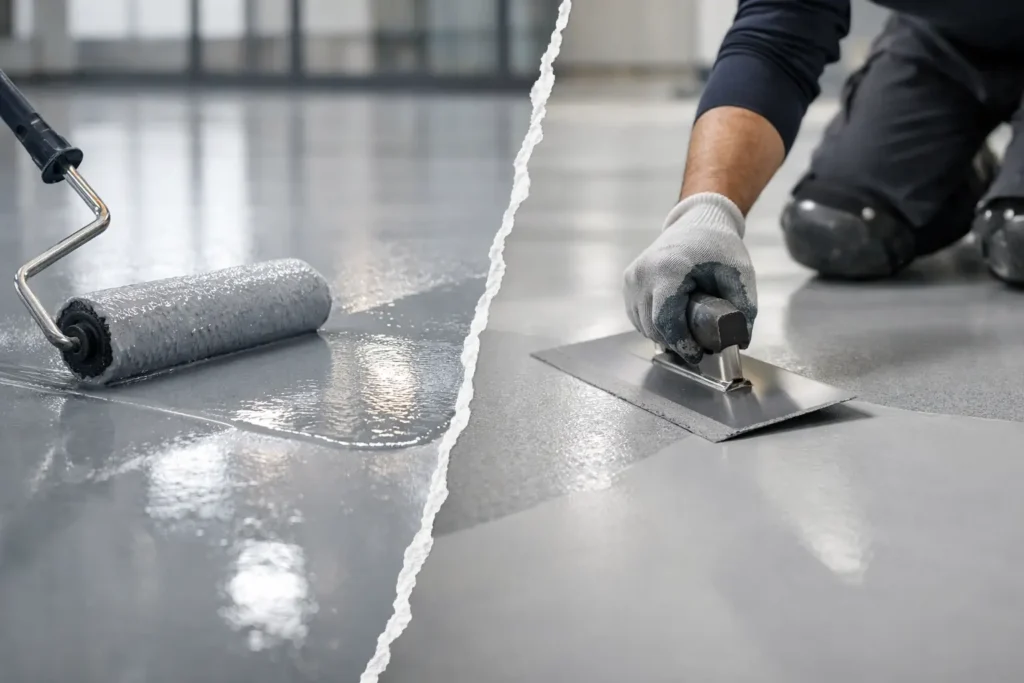
A floor can set the entire character of a space long before the furniture, lighting or artwork is in place. That is why the choice between epoxy versus polyurethane flooring should be about more than a technical specification. Both can create a seamless, high-performance surface, but they behave differently under sunlight, footfall, changing temperatures and daily life.
For a statement kitchen, a polished retail space or a hard-working garage, the right resin system is the one that meets the practical demands without compromising the intended aesthetic. Epoxy often brings depth, strength and creative freedom. Polyurethane brings flexibility, comfort and impressive resistance to UV exposure. The best choice depends on the environment and the finish you want to live or work with every day.
Epoxy versus polyurethane flooring: the essential difference
Epoxy is a thermosetting resin coating created by mixing resin and hardener. Once cured, it forms a dense, hard surface with excellent adhesion to properly prepared concrete. It is widely valued for its strength, chemical resistance and ability to carry decorative finishes, from subtle mineral effects to bold metallic movement and terrazzo-inspired detail.
Polyurethane, often called PU, is a more flexible resin system. It can withstand slight movement in the substrate and absorbs impact better than epoxy. Its key advantage is its elasticity: where a hard epoxy coating may be more prone to showing damage from a sharp impact or structural movement, polyurethane has more give.
Neither material is automatically superior. They are designed to solve different problems. In many premium floor specifications, they are used together: an epoxy base layer provides adhesion and build, while a polyurethane topcoat adds UV stability, scratch resistance or a chosen sheen.
Where epoxy flooring excels
Epoxy is a natural choice where visual impact and heavy-duty performance need to sit side by side. Its glossy, glass-like depth makes it particularly suited to decorative resin floors, including metallic finishes, coloured systems and aggregate blends. It can turn a previously ordinary concrete slab into a deliberately designed surface rather than a background material.
In practical terms, epoxy performs well against oils, many chemicals and repeated cleaning. This makes it a strong contender for garages, workshops, warehouses, commercial kitchens and retail units. A correctly installed epoxy system has no grout lines for dirt to collect in, making cleaning simpler than with many tiled finishes.
For residential interiors, epoxy can create a crisp contemporary result in hallways, utility rooms, kitchens and feature spaces. It is especially effective when the brief calls for continuity between areas, with a smooth finish that carries the eye through the room.
The trade-off is hardness. Epoxy is less forgiving underfoot than some other finishes, particularly in areas where people stand for long periods. It can also be less tolerant of movement in the concrete below. Good preparation, suitable primers and realistic assessment of the substrate are central to a lasting outcome.
Epoxy and sunlight
Standard epoxy can amber or change in appearance when exposed to prolonged direct sunlight. This does not make it unsuitable for every bright room, but it does mean the specification needs thought. A sun-filled extension, shopfront or space with wide bi-fold doors may benefit from a UV-resistant polyurethane topcoat or a different resin system altogether.
This matters most for pale, white or lightly pigmented floors, where even a subtle colour shift can become noticeable. Richer tones and decorative effects can disguise change more successfully, but they should never be relied upon as a substitute for the right protective finish.
Why choose polyurethane flooring?
Polyurethane flooring is often selected for spaces that need durability with a little more flexibility. Its softer feel can make it more comfortable in homes, showrooms, schools and workplaces where people spend substantial time on their feet. It is also more resistant to scuffs and light abrasion than many standard epoxy finishes.
PU is particularly useful where the concrete substrate may experience slight movement or where temperature changes are more pronounced. That can be relevant in ground-floor spaces, outbuildings, commercial premises and areas with large glazed elevations. Its flexibility helps it accommodate minor expansion and contraction rather than fighting against it.
It also offers strong UV resistance. A polyurethane finish is less likely to yellow in daylight, making it a compelling option for bright interiors and exterior-adjacent spaces. For a clean, pale seamless floor that receives regular sun, this quality may be the deciding factor.
Polyurethane is not always the ideal starting point, however. It may not provide the same decorative depth or broad creative effects associated with epoxy. Some PU systems can also be more sensitive during installation, with humidity, temperature and timing all affecting the final cure. This is precisely why resin flooring should be designed as a system, not selected from a single product description.
Design potential and finish quality
For design-led interiors, epoxy usually offers the wider artistic palette. It can be layered with pigments, metallic powders, decorative flakes and aggregates to create surfaces with movement, depth and individuality. A floor can be calm and stone-like, expressive and reflective, or finely detailed to echo terrazzo without the joints and weight of traditional materials.
Polyurethane tends to lend itself to a more restrained, refined visual language. It is available in a variety of colours and sheens, from practical satin to a more polished finish, but it is often chosen for performance as much as visual drama. As a topcoat, it can protect an epoxy design while preserving the intended colour and controlling how much light the floor reflects.
Sheen deserves careful consideration. High gloss can make a space feel expansive and dramatic, especially with metallic or deep-toned resin. It can also show dust, footprints and surface marks more readily. Satin and matt finishes create a quieter, more architectural look and can be easier to live with in busy households. The best finish is not simply the most striking sample – it is the one that suits the light, traffic and maintenance expectations of the completed space.
Durability is about the whole floor system
Comparing resin materials in isolation can be misleading. The longevity of a floor depends on concrete condition, moisture levels, surface preparation, primers, layer thickness, joint detailing and curing conditions. Even an excellent resin can fail if applied over a weak, contaminated or damp substrate.
Epoxy generally has the edge for compressive strength and chemical resistance, which is valuable in industrial and garage settings. Polyurethane has the edge for flexibility, UV stability and resistance to day-to-day scuffing. But a commercial warehouse with forklift traffic needs a different build-up from a bathroom floor, just as a decorative hallway needs a different approach from a vehicle workshop.
In high-traffic spaces, texture can be incorporated to improve slip resistance. This should be balanced carefully. An aggressively textured surface may be safer in wet or industrial areas, but it is harder to clean and can feel out of place in a refined residential setting. A tailored anti-slip finish can retain the visual quality of resin while giving the floor the grip its environment requires.
Maintenance, repairs and everyday living
Both epoxy and polyurethane floors are straightforward to maintain when specified and installed correctly. Regular sweeping or vacuuming removes abrasive grit, while a pH-neutral cleaner and soft mop will handle routine washing. Avoid harsh products that leave residues or gradually dull the finish.
No resin floor is entirely immune to damage. Dragging metal furniture, dropping sharp tools or allowing grit to build up can mark even a high-quality surface. Polyurethane may cope better with scuffs and minor impacts, while epoxy’s hard surface can be more vulnerable to chipping from a concentrated blow.
Repairs are possible, but a perfect invisible repair is not guaranteed, particularly on highly decorative or metallic epoxy floors where pattern movement is unique. This is another reason to choose a finish that suits real use, rather than selecting purely from a small sample. Thoughtful detailing at the outset protects the finished design for longer.
Which resin floor is right for your space?
Choose epoxy when you want high-build strength, chemical resistance and a floor with real decorative presence. It is particularly effective for garages, workshops, warehouses, retail environments and interiors where a bespoke seamless statement is part of the design brief.
Choose polyurethane when UV resistance, flexibility, underfoot comfort and scuff resistance are priorities. It is well suited to bright rooms, areas subject to subtle movement and spaces where people stand or walk frequently.
For many projects, the strongest answer is not epoxy or polyurethane, but epoxy beneath polyurethane. This combined approach can deliver the depth and adhesion of epoxy with the protective, flexible qualities of a PU wear layer. At Resinize, that conversation begins with the space itself: how it is used, how light moves through it, what sits above the slab and what kind of finish will still feel considered years from now.
A resin floor should not ask you to choose between artistry and performance. With the right material, preparation and finish, it becomes the surface that quietly supports daily life while giving the whole room a more deliberate sense of character.