
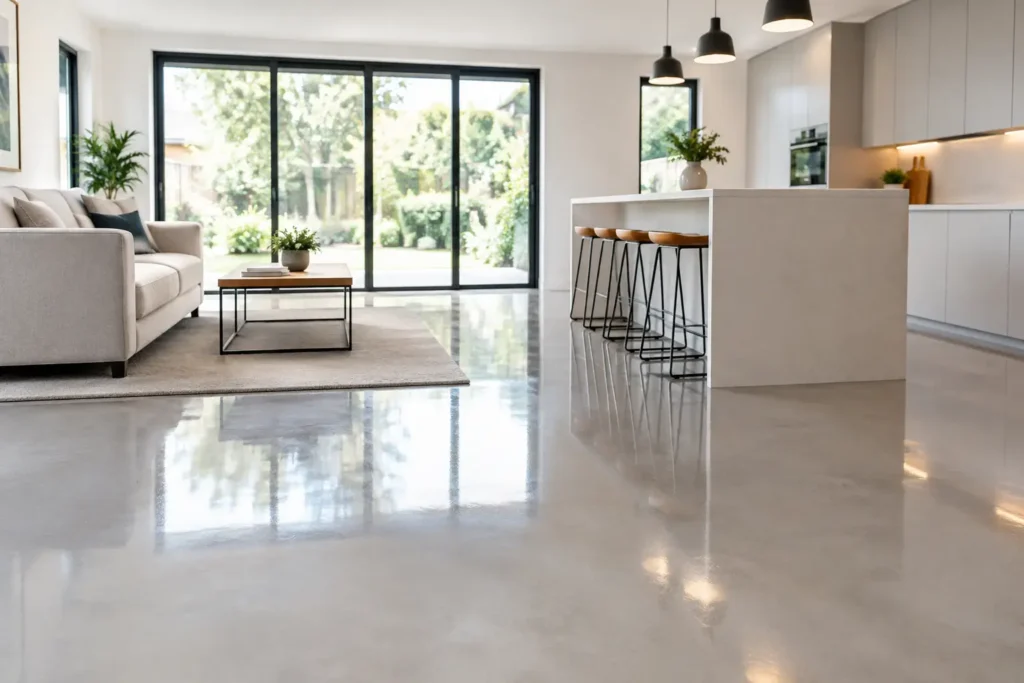
A tired floor can quietly undermine an otherwise considered room. Scuffed grout, mismatched thresholds and worn coverings create visual noise, particularly in kitchens, hallways and open-plan spaces where the floor is always in view. So, can resin flooring increase property appeal? When it is designed for the space and installed with care, it can give an interior the clarity, character and finish quality that people notice immediately.
Resin is not a shortcut to adding value, nor is it the right choice for every property. Its appeal lies in its ability to turn a large, practical surface into part of the design. A seamless floor can make a compact bathroom feel calmer, give a kitchen a more architectural edge or help a commercial setting look purposeful from the moment someone enters.
Can resin flooring increase property appeal in practice?
Property appeal is shaped by feeling as much as specification. Buyers, tenants, visitors and customers tend to respond to spaces that look well maintained, easy to live with and distinctive without being difficult to imagine as their own. Resin flooring can support all three, especially where it replaces dated finishes with a continuous, tailored surface.
Unlike tile, vinyl planks or traditional laminate, a poured resin floor has no repeated joins interrupting the room. That uninterrupted plane can create a sense of scale, allowing cabinetry, lighting, joinery and artwork to carry more visual impact. In a hallway, it can make a strong first impression. In a kitchen-diner, it can connect cooking, eating and living zones without competing with the rest of the scheme.
The strongest results are rarely about choosing the boldest finish. A warm concrete-effect resin, softly flecked terrazzo-inspired overlay or restrained neutral epoxy can feel more enduring than a trend-led colour. The aim is to create a finish that feels intentional and proportionate to the building.
A design feature that works hard
A property improvement earns its place when it looks refined after the excitement of installation has passed. Resin flooring is valued because its design potential comes with practical performance. Once correctly specified and cured, it creates a durable, easy-clean surface suited to the reality of busy homes and demanding commercial environments.
In residential spaces, the absence of grout lines can make day-to-day cleaning more straightforward. There are fewer places for dirt to gather, and spills can generally be dealt with quickly. That matters in entranceways with muddy shoes, kitchens with constant footfall and bathrooms where a clean, calm finish is part of the appeal.
For commercial properties, the visual benefit carries a different kind of weight. A polished retail floor can reinforce a considered brand environment, while a hard-wearing coating in a garage, warehouse or workshop can make the space look cared for as well as fit for purpose. The right resin system can be selected around expected traffic, cleaning regimes and the nature of the work taking place there.
Seamlessness changes how a room reads
Flooring is one of the few finishes that stretches across an entire interior. When it is fragmented, the room can feel fragmented too. A continuous resin surface reduces those visual breaks and can make awkward layouts read as one coherent space.
This is particularly effective in extensions and renovations, where new and old areas need to feel connected. Carrying one resin finish through a kitchen, utility room and hallway can bring visual order to the plan, while allowing each area to retain its own furniture, lighting and function.
Bespoke colour brings character without clutter
The assumption that resin floors are only grey, glossy and industrial is outdated. Decorative aggregates, pigment choices, matte or satin finishes, metallic movement and concrete-inspired textures allow for a far more individual result. The finish can be quiet and mineral-like, richly expressive or somewhere between the two.
For resale appeal, the most successful choices often balance personality with flexibility. Soft stone tones, warm greys, off-whites and subtle terrazzo-style blends can feel contemporary while leaving future owners room to introduce their own furnishings. For a commercial setting, a more distinctive colour or decorative effect may be exactly what creates memorability.
Where resin adds the most visual value
The rooms that gain most are often those where conventional flooring has to work particularly hard. Kitchens and hallways benefit from resilience and a unified appearance. Bathrooms can take on a spa-like quality when walls and floors are designed in complementary seamless finishes. Garden rooms and summer houses can feel like proper extensions of the home rather than separate, temporary spaces.
In open-plan interiors, resin can also help a project feel more expensive because it supports a cleaner architectural language. There is no need to introduce metal trims between every zone or accommodate the pattern repeat of a manufactured product. The surface becomes a backdrop for the whole room.
Commercially, an upgraded floor can change perceptions before a customer speaks to a member of staff. In a showroom or retail unit, it can make displays feel more curated. In a reception area, it signals attention to detail. Even in functional spaces, a well-finished floor suggests operational standards that clients and employees can trust.
The trade-offs worth considering before you choose resin
A premium result depends on preparation. Resin is applied over a substrate, so the condition of the existing floor matters. Moisture, movement, contamination and cracks must be assessed rather than covered over in the hope that they will disappear. This is why professional survey, substrate preparation and system selection are central to the finished appearance.
It is also worth being honest about style. High-gloss resin can look striking, but it may show dust, marks or surface scratches more readily than a softer satin or matt finish. A pale floor can brighten a room, yet darker or busier decorative finishes may be more forgiving in a household with children, pets or heavy outdoor use. The best finish is not simply the most photogenic sample. It is the one that suits the light, use and character of the property.
Installation can require areas to be kept clear while the floor is prepared, applied and cured. Timelines vary according to the system, substrate and design, so this should be planned around a renovation schedule rather than treated as a last-minute decision. Good craftsmanship is patient work, especially where seamless transitions and decorative effects are involved.
Designing for appeal, not just for the photograph
A floor should relate to the property rather than overwhelm it. Period homes can benefit from a terrazzo-inspired finish that introduces texture without pretending to be original heritage material. Newer homes often suit a smooth concrete effect or refined neutral epoxy that strengthens their clean lines. In either case, samples should be viewed in the actual room, at different times of day and alongside cabinetry, paint and tile choices.
Scale matters too. A small space may suit a simple, light-reflecting finish, while a generous open-plan room can accommodate more movement or aggregate detail. Edges, thresholds and skirting decisions deserve the same attention as colour, because these are the details that make a surface feel integrated rather than merely installed.
For homeowners in Essex and London, where renovation projects often involve tight footprints, extensions and high-use family spaces, a bespoke resin floor can be especially valuable as a way to simplify the visual language of the home. Resinize approaches each surface as both a technical installation and an opportunity to craft atmosphere, helping clients choose a finish that feels considered long after the first impression.
A finish that helps people imagine themselves there
The most appealing properties do not necessarily contain the most expensive materials. They feel resolved. Their surfaces work together, their practical details have been considered, and there is a sense that everyday life will be easier within them.
Resin flooring can contribute to that feeling with a surface that is distinctive, durable and made for the particular space it occupies. Choose it for the right reasons – visual continuity, tailored character and lasting everyday performance – and it can become the finish that makes a room feel not just updated, but complete.