
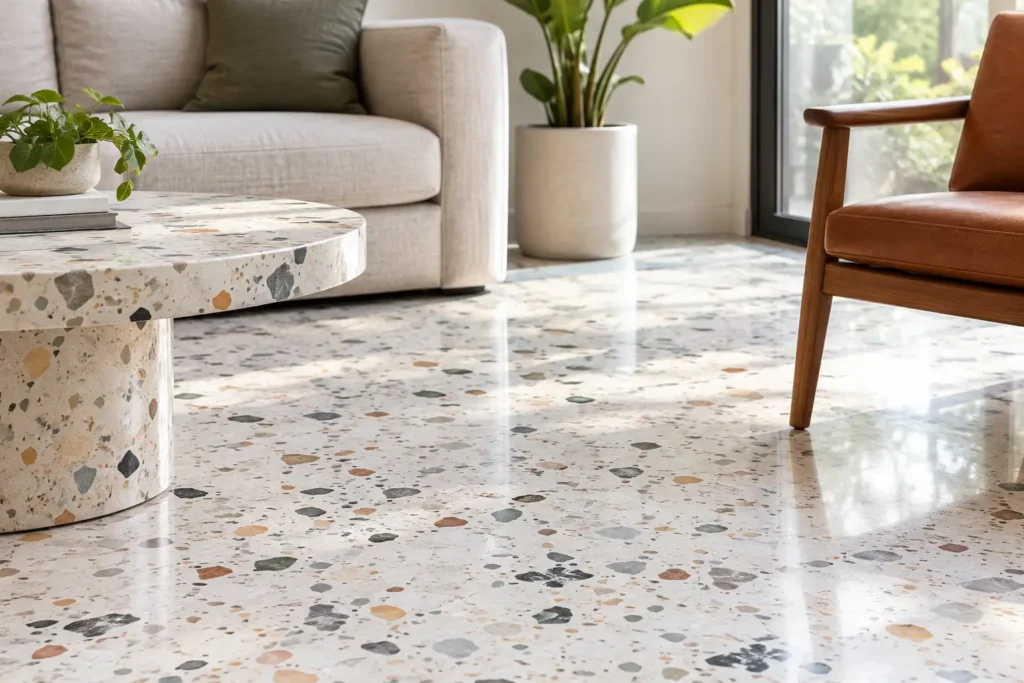
A terrazzo floor no longer has to mean a loud, high-contrast pattern or a cold institutional finish. The most compelling terrazzo overlay design trends are more considered: softly layered aggregates, warmer base tones, tailored colour palettes and seamless detailing that makes the entire room feel more intentional. For homeowners and commercial designers alike, the appeal lies in creating a surface with character that still performs beautifully under everyday life.
A resin terrazzo overlay offers a particularly flexible way to achieve that look. Rather than working around the limitations of pre-cast tiles or traditional poured terrazzo, the finish can be composed around the architecture, lighting and use of the space. The result can be quiet and refined, bold and expressive, or somewhere between the two.
Terrazzo overlay design trends are becoming more personal
The strongest movement in surface design is away from one-size-fits-all schemes. Clients are choosing finishes that relate to their cabinetry, joinery, wall colours and brand identity rather than selecting a generic speckled floor from a sample board.
This does not always mean choosing more colour. In many contemporary interiors, personality comes from restraint: a warm ivory resin ground with stone-toned flecks, or a pale grey base softened with sand, chalk and muted clay aggregate. These surfaces hold visual interest without taking over the room. They are particularly effective in open-plan kitchens, hallways and retail settings where the floor connects several distinct zones.
At the other end of the spectrum, custom terrazzo-inspired overlays are becoming a feature in their own right. A carefully placed blend of black, rust, sage, cobalt or soft pink can turn a café counter area, studio entrance or bathroom into a memorable design moment. The difference between a statement floor and visual noise is proportion. A confident palette needs enough calm around it, whether that comes from plain walls, simple furniture or a restrained aggregate mix.
Warmer neutrals are replacing clinical grey
Grey still has a place, especially in contemporary commercial spaces and concrete-led interiors, but it is no longer the automatic starting point. Warm whites, mushroom, biscuit, putty and pale taupe are bringing a softer architectural feel to terrazzo overlays.
These shades suit the way many British homes are now being designed: natural oak, brushed metals, textured plaster, off-white cabinetry and layered lighting. A warmer resin base can make a hallway or kitchen feel composed from the moment you enter, while allowing darker joinery and colourful accessories to stand out.
There is a practical benefit, too. Mid-warm tones tend to be forgiving in spaces with regular footfall. They can disguise the everyday traces of a busy household better than a very pale floor, while still retaining the lightness that makes compact rooms feel more generous.
The return of earthy, mineral colour
Terracotta, olive, deep brown and muted blue are increasingly appearing as accent chips rather than full-floor colours. This approach gives a terrazzo overlay depth without making it feel themed. It also creates a useful connection between floor and furnishings, perhaps picking up the colour of a painted island, upholstered seating or a feature wall.
For commercial spaces, a restrained brand colour worked into the aggregate can be more sophisticated than applying logos or graphics everywhere. It gives the interior a recognisable identity while keeping the finish practical and enduring.
Bigger aggregate, finer detail
Scale is changing. Fine speckle remains popular for calm, almost stone-like floors, but larger aggregate pieces are gaining attention in feature spaces. A larger chip can feel bolder and more graphic, particularly when set against a simple, matte or satin resin ground.
The best choice depends on the room. Larger chips need space to read properly, so they often suit reception areas, generous kitchens, retail floors and expansive dining zones. In a small cloakroom or compact bathroom, a fine or mixed aggregate blend can create texture without making the floor feel busy.
Mixed-scale terrazzo is another considered option. Combining a dominant fine aggregate with occasional larger pieces creates a more natural, layered appearance. It has the crafted quality people associate with traditional terrazzo, but can be tailored to a cleaner, more contemporary setting.
Seamless zoning is shaping modern layouts
Open-plan rooms demand surfaces that work hard visually. A terrazzo-inspired resin overlay can flow continuously from kitchen to dining area, hallway to living space, or reception to retail floor, without the grout lines that interrupt the eye. This continuity is one reason seamless surfaces are becoming central to modern renovations.
Zoning does not have to mean changing materials. A shift in aggregate density, a curved colour field or a defined border can distinguish one area from another while preserving a cohesive floor. For example, a kitchen can have a subtly denser terrazzo blend around the island, fading into a quieter field through the dining area. In a commercial setting, this can help guide movement through a showroom or create a welcoming threshold at an entrance.
There is a trade-off. More intricate zoning requires careful planning before installation, particularly where cabinetry, thresholds and fixed furniture meet the floor. It is worth resolving these details early, because the most successful seamless interiors are designed as a whole rather than treated as a series of separate finishes.
Matte and satin finishes feel more architectural
High-gloss resin can create dramatic reflection, and it remains a strong choice for certain retail, hospitality and feature-led environments. Yet the current preference in many homes is for a softer sheen. Matte and satin finishes feel calmer under natural light, bringing the aggregate forward rather than turning the floor into a mirror.
A satin finish is often a balanced choice for kitchens, hallways and commercial interiors. It has enough light play to feel polished, while being less revealing of everyday marks than a full gloss surface. The right finish should be chosen with lighting and use in mind. A room with strong south-facing sunlight may benefit from a lower sheen, while a darker basement studio can carry more reflectivity.
Terrazzo moves beyond the floor
One of the more creative terrazzo overlay design trends is the use of a consistent finish across multiple surfaces. A floor can continue up a low plinth, wrap a reception desk, form a vanity surround or provide a durable backdrop to built-in seating. Used selectively, this creates a beautifully unified architectural effect.
Bathrooms are especially suited to this approach. A seamless terrazzo-style floor paired with a coordinated wall finish can reduce visual clutter and make a smaller room feel more expansive. The resin system and specification must, of course, be suited to wet areas and prepared correctly for the substrate beneath. Design ambition should always be supported by the right technical approach.
For a kitchen or hospitality setting, terrazzo-style resin on a counter front or feature wall can offer a more individual alternative to standard tile. It is a chance to carry a chosen colour story through the room without repeating the same material in an obvious way.
Performance is part of the design brief
A beautiful overlay is only successful if it suits the life happening on top of it. Kitchens need a finish that stands up to spills, foot traffic and regular cleaning. Garages and warehouse environments call for a heavier-duty specification, with the right resistance and slip considerations. Retail floors must balance visual impact with durability under constant use.
This is where a bespoke consultation matters. The aggregate blend, resin system, sheen and preparation method should be selected together, not as separate decisions. An impressive sample is useful, but it should be viewed alongside the room’s light, existing materials and practical demands.
For older properties in Essex or London, substrate condition can be especially relevant. Existing floors may need repair, levelling or moisture assessment before an overlay is installed. Addressing that groundwork protects both the finish and the investment, allowing the final surface to look effortless for the right reasons.
Choosing a trend that will still feel right later
The most lasting terrazzo interiors are not built around a fleeting colour or a social-media moment. They begin with the atmosphere a space needs to create. A calm family kitchen may call for warm neutrals and fine mineral detail; a creative workspace may benefit from bolder scale and colour; a customer-facing setting may need a finish that quietly reinforces the brand.
Terrazzo-inspired resin gives designers and property owners room to make those choices with precision. When the palette, aggregate and sheen are crafted around the space rather than copied from a trend board, the floor becomes more than a backdrop. It becomes part of the architecture people remember.